Trek difficulty
Moderate - Difficult
Trek duration
7 Days
Trek altitude
14107 Ft.
Group size
6-12
Trek distance
72
Basecamp
Gagangir
Best Time
June to September
Pickup Point
Srinagar
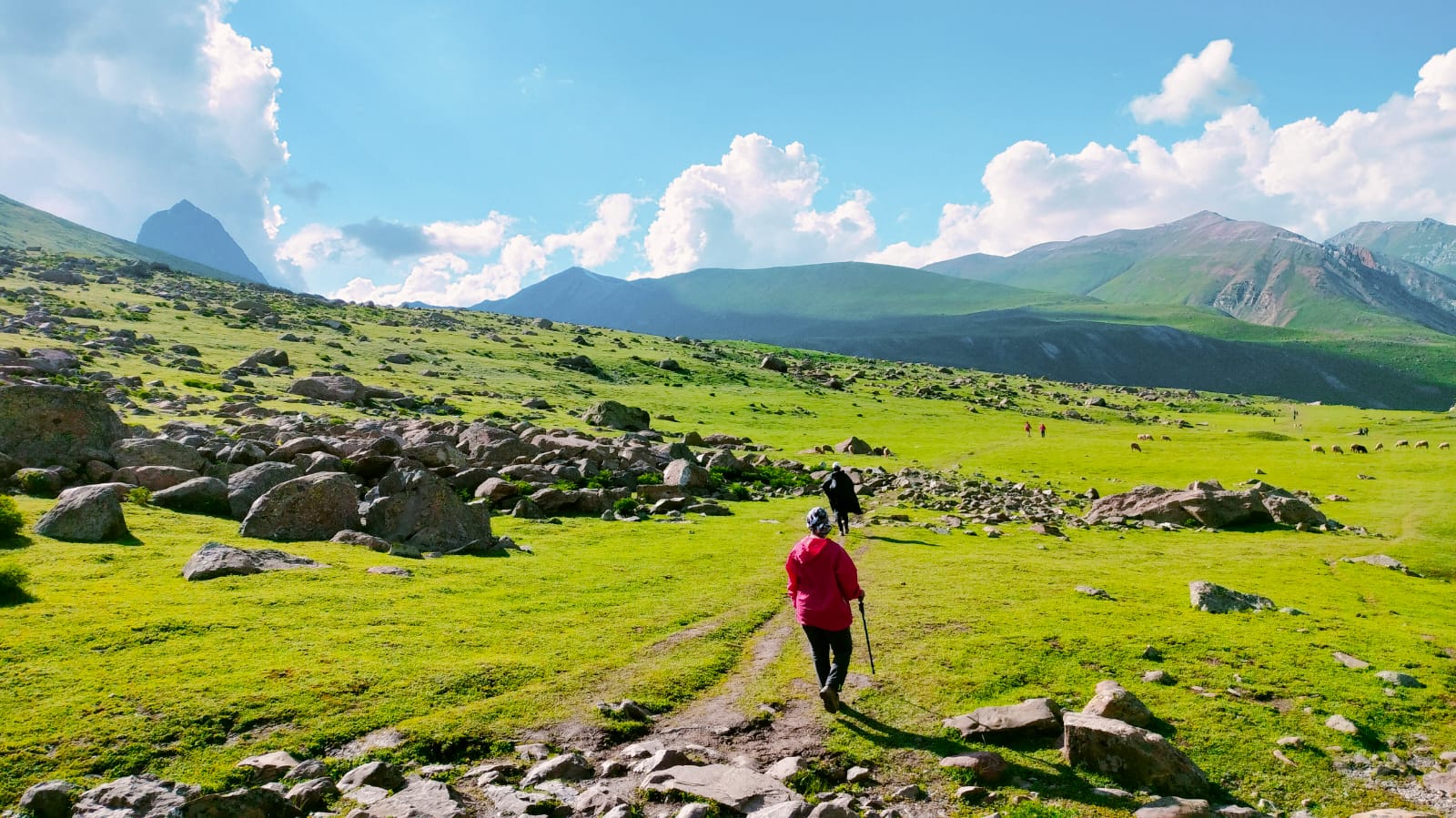
The Kashmir Great Lakes Trek is a popular trekking route in the Indian Himalayas. Located in the Jammu and Kashmir, the Indian-administered region, this trek involves several breathtaking alpine lakes, lush meadows, dense forests, and wild mountain vistas. This 72-kilometer trek takes approximately 7 to 9 days and reaches elevations of up to 4,300 meters (14,107 feet).
This page covers a complete trek guide to Kashmir Great Lakes, including an itinerary and other important information.
Kashmir, the Trekking Capital of India Kashmir has long been known as the trekking capital of India. This Heaven on Earth is continues to offer unmatched views –emerald lakes, mysterious alpine forests, dreamy meadows, snow-draped peaks-unfolding in almost all the treks in Kashmir. Where Uttarakhand and Himachal treks pull significant group of trekkers, Kashmir is still unparalleled when it comes to offbeat and less discovered trails. Even in the year 2027, Kashmir still is going to be crown jewel of Indian trekking destinations.
If you are planning summer treks in Jammu and Kashmir in 2027, congratulations as the season will make you experience diversity. Kashmir has everything that one can wish for-right from iconic trails of Great Kashmir Lakes to hidden gems like Nafran Valley, Silent Meadows, Warwan Valley and Tosa Maidan. Whether it is going to be your first trek ever or another adventure –trekking in Kashmir delivers something that matches the taste of everyone.
Intends to bring complete look at the best summer treks in Kashmir for 2027 along with picking up best and most suitable trek, their highlights, and best time to visit. But before that let’s learn why Kashmir Treks should be your first choice is summer.
Why Choose Trekking in Kashmir?
High-altitude Lakes: no other trekking region in India offers numerous alpine lakes
Sweeping Meadows: witness vibrant wildflowers full in bloom in the months of July and August
Diverse Landscape: get to see everything in one trail-lush forests, frozen glaciers, serene lakes, and endless meadows
Proximity: the best part is that many treks are closer to Srinagar-ensuring safety
Untouched Trails: many trails are unexplored and haven’t discovered by mainstream crowds
A Background on the Kashmir Great Lakes Trek
The Kashmir Great Lakes, a unique and incredible trekking destination, is a fusion of natural beauty and cultural significance, and the challenging terrain makes this trek a perfect escape for all the nature lovers. Depending upon your pace and fitness level, we stretch your trek days. However, below we have mentioned the process to obtain a permit, regular itinerary, which will cover the highlights and route of the journey you will take with us. After the itinerary, we have also mentioned the key points to keep in mind when planning a trip like the Kashmir Great Lakes Trek.
Why This Trek Is So Special
Among all treks in Jammu and Kashmir, the Kashmir Great Lakes Trek stands out for its scenic variety. The view changes almost every day, one day from flower-filled grasslands and rocky ridges to the next day with snowy patches and high mountain passes and still maintains to keep every visitor’s heart struck.
Another defining feature is the remoteness of this lake trek Kashmir. Most of the areas have no roads or mobile connectivity, allowing trekkers to disconnect from their everyday life in city and reconnect with themselves in the form of nature. The depth that comes to the journey through this isolation, makes the whole great lakes trek experience feel personal.
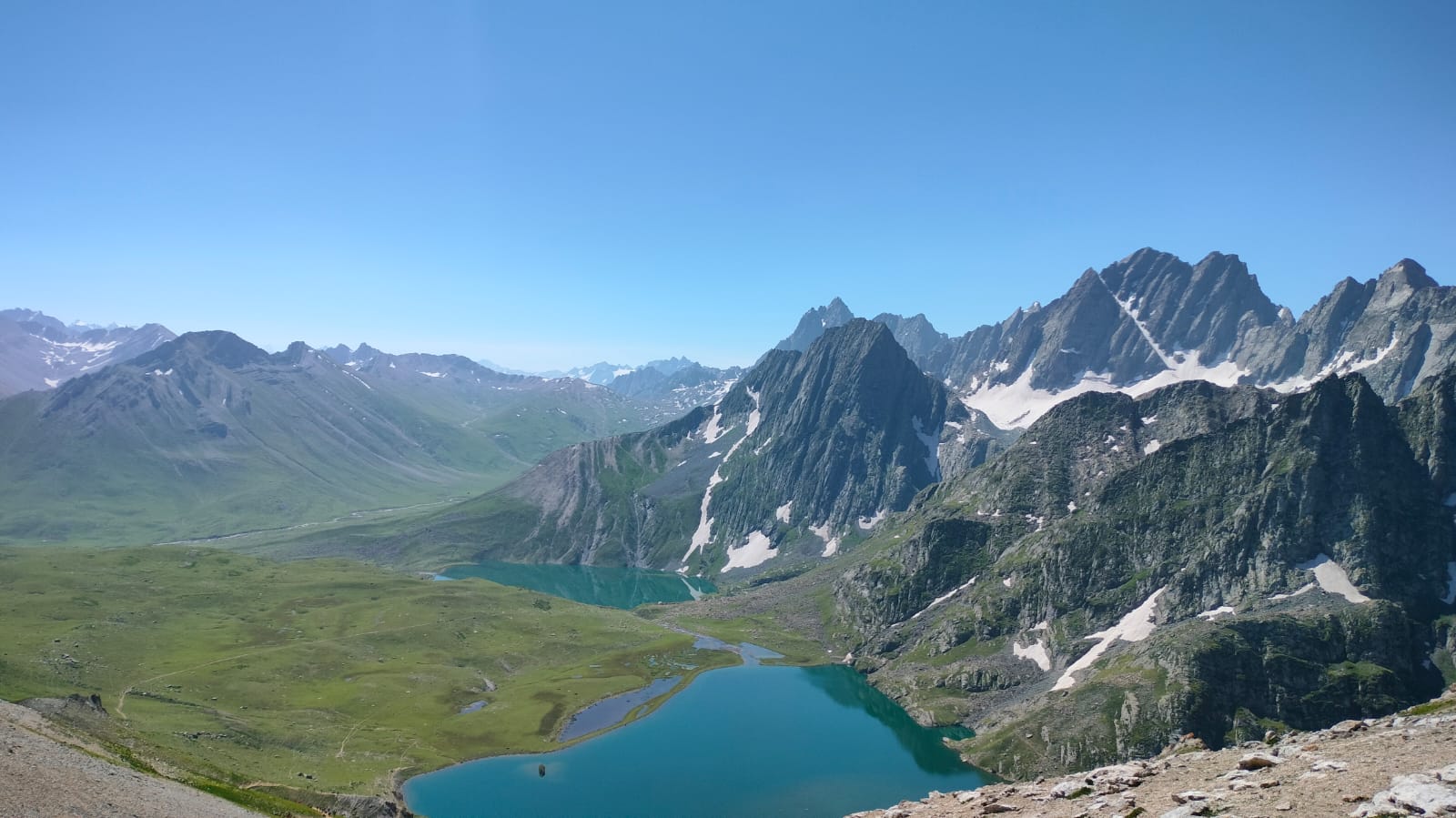
The Iconic Alpine Lakes of the Trek: The focus of the Kashmir Great Lakes Trek belongs to its iconic 7 lakes trek, each representing a surreal environment in its own unique way.
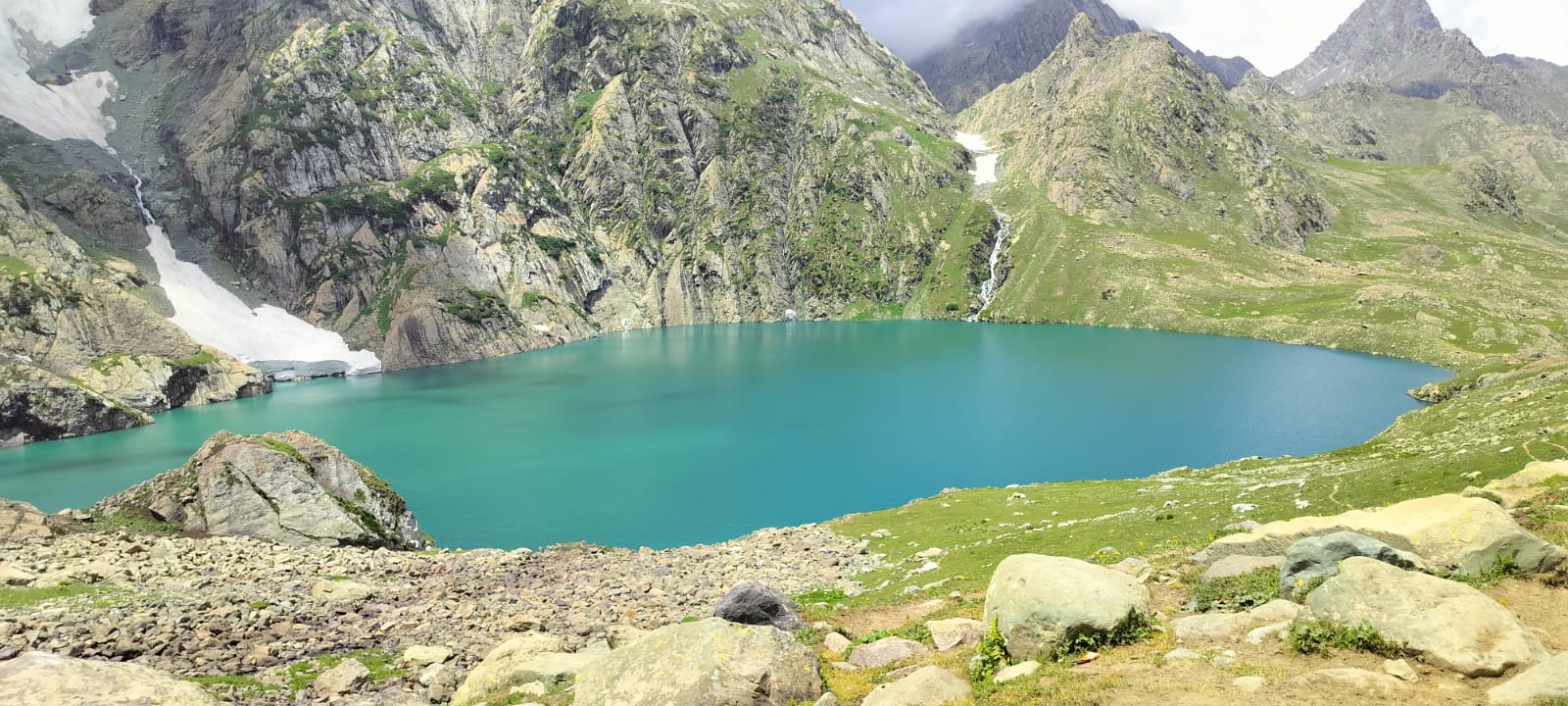
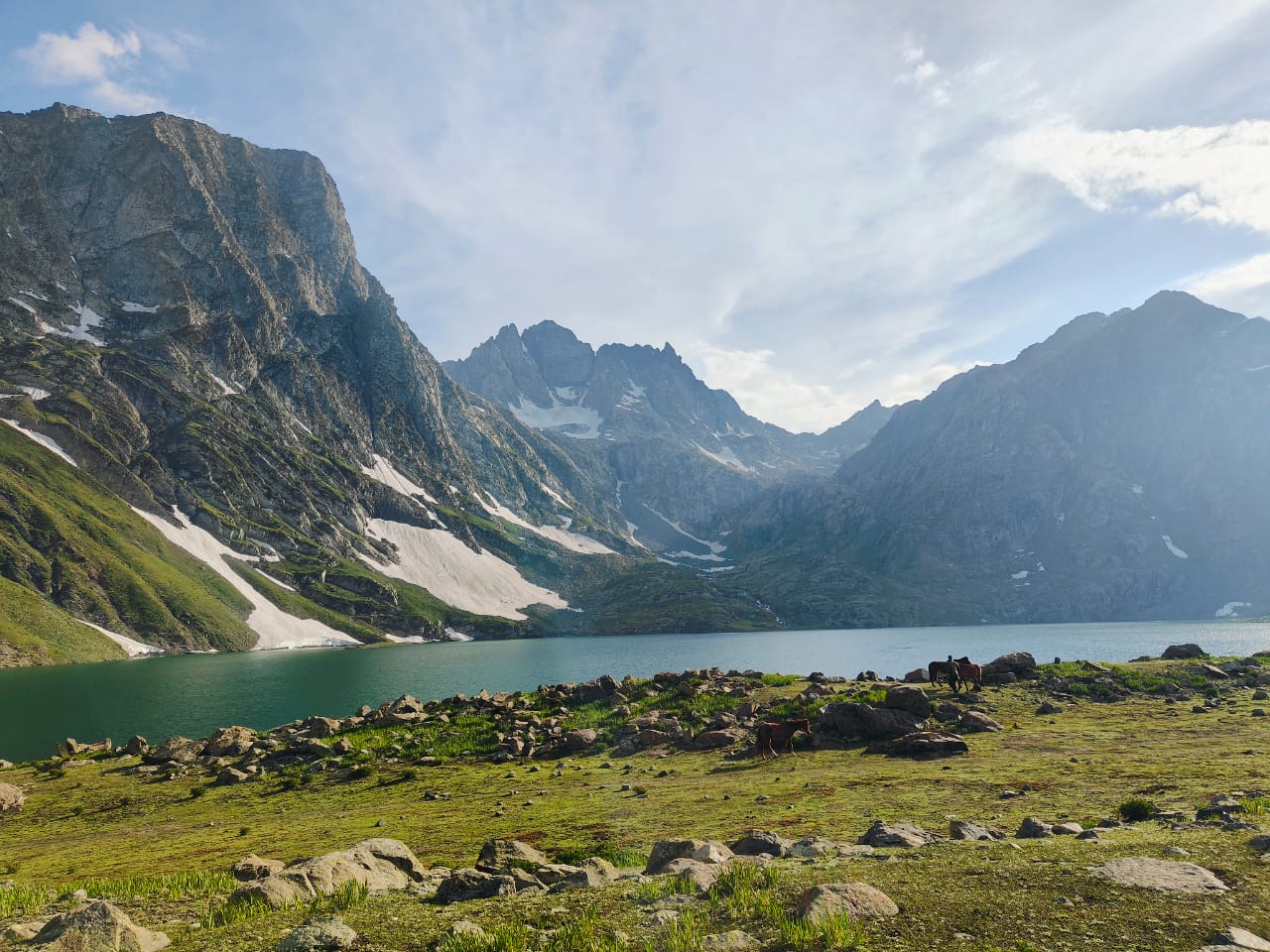
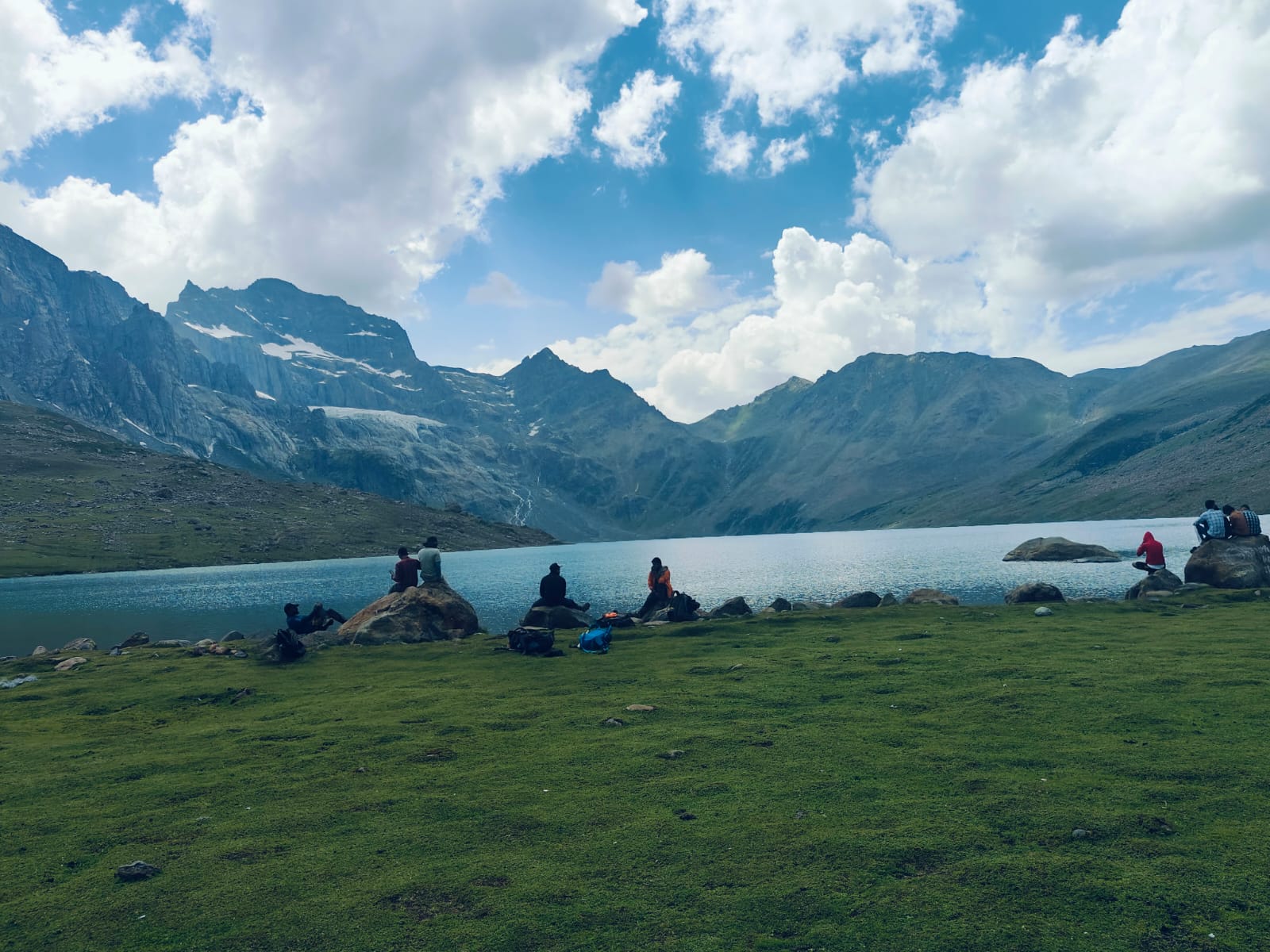
Vishansar Lake:Vishansar Lake is comes in sight as one of the first major lakes on the trek. Its deep blue waters are prepared by melting snow, and ice can still be seen floating near the edges, early in the season. And of course, the meadows surrounding it, adds to its peaceful setting.
Kishansar Lake: Situated nearby Vishansar, Kishansar Lake feels broader and calmer. The stillness on the water surface reflects the mountains all around, creating an eye catchy visual, especially during clear weather, making directly its way to your collection of Kashmir great lakes trek photos.
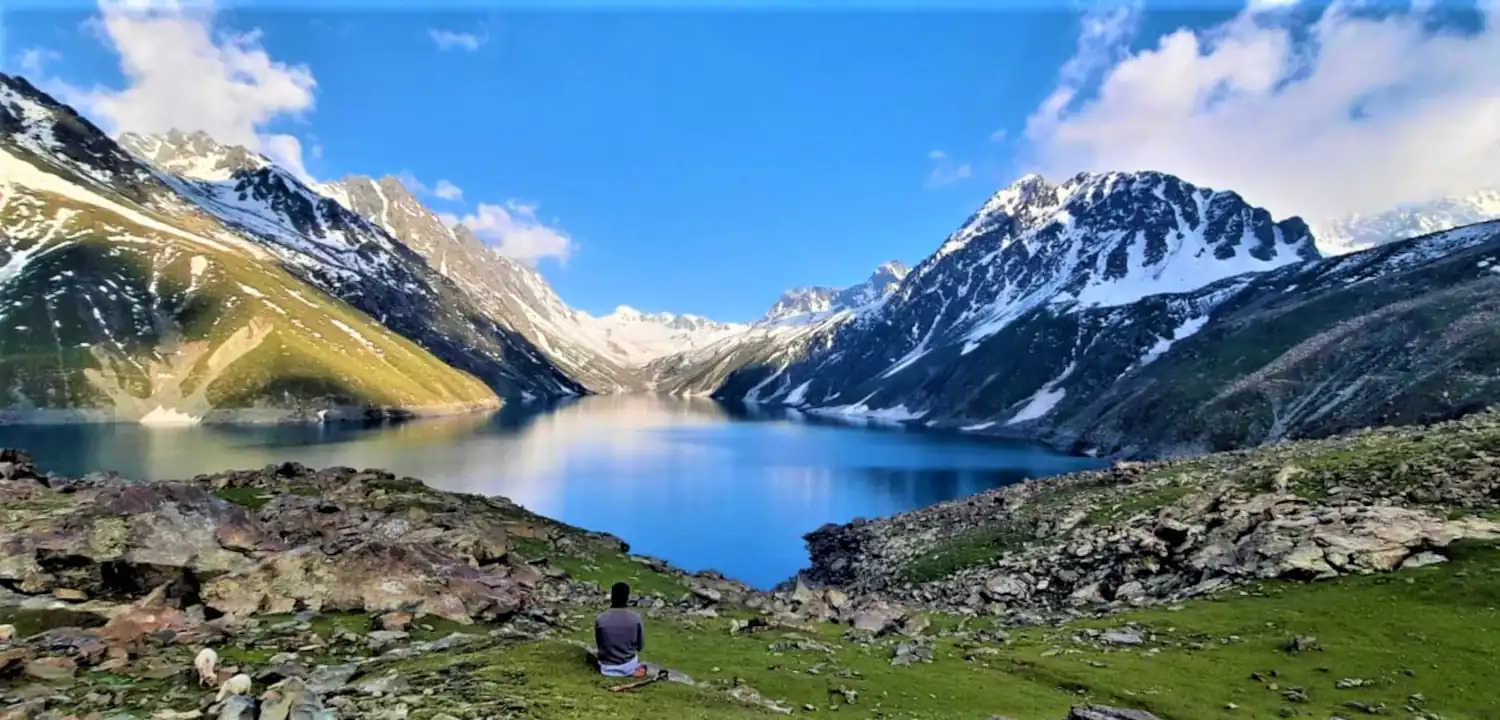
Gadsar Lake: Often referred as the most beautiful lake on the trail, the views of Gadsar Lake are achieved only after going through the demanding Gadsar Pass. Wildflowers blooming around the corners, and sheep on their everyday grazing hours are usual sight during the summer season. All these combined makes great lakes trekking an unforgettable experience.
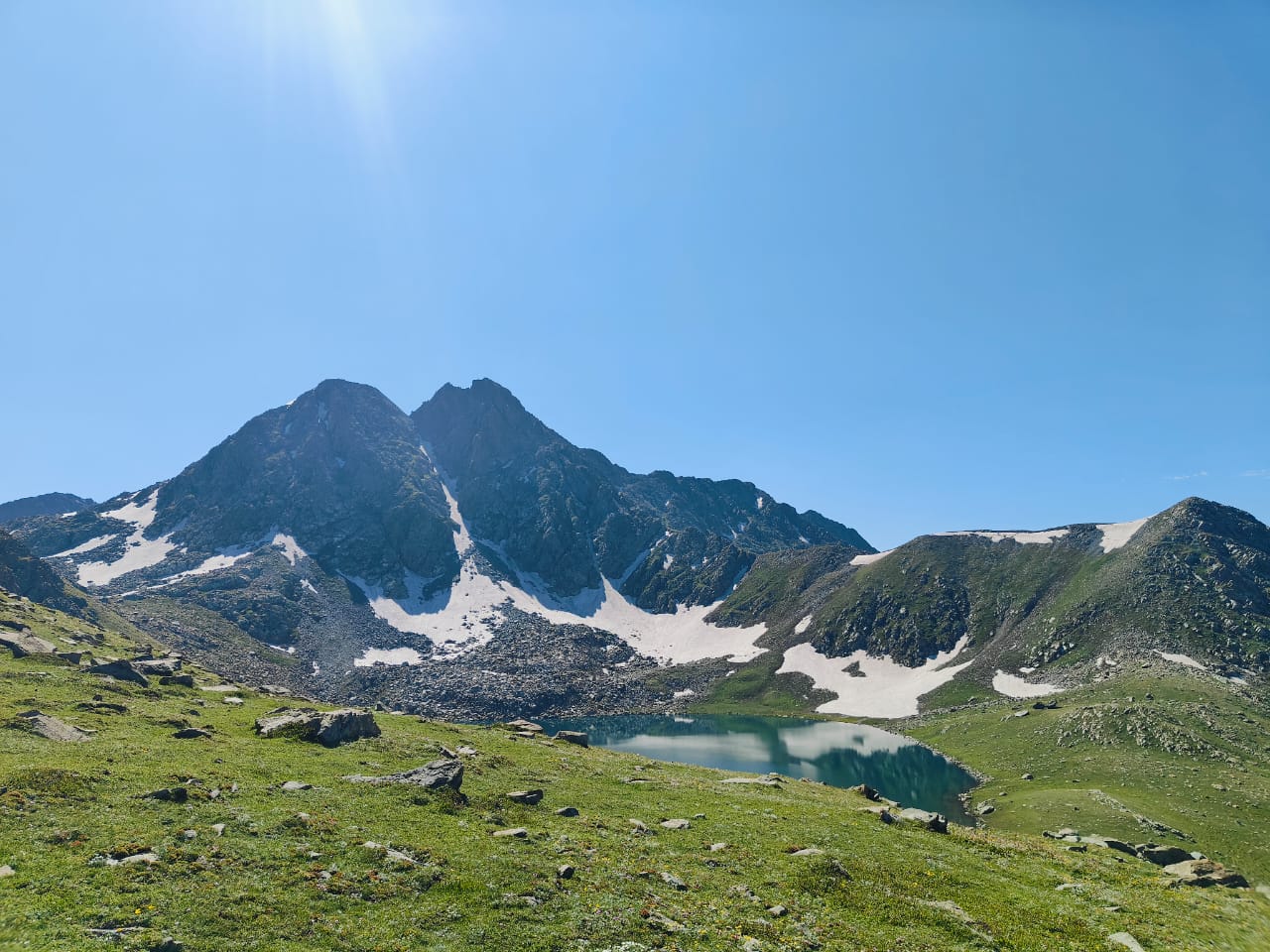
Satsar Lakes:The Satsar Lakes are a group of interconnected water bodies that’s across a wide valley. The landscape here is breathtaking in whole another way while being quiet at the same time and only with limited trekkers passing through, making it one of the most serene parts of the lakes trek Kashmir.
Gangbal and Nundkol Lakes: The trek concludes itself by Gangbal and Nundkol Lakes, situated at the base of Mount Harmukh. These twins of lakes in Kashmir have cultural as well as spiritual significance for locals and also provides a dramatic and memorable conclusion to the journey.
The Valley Between Worlds : The map shows Kashmir as a mountain leaf which appears as a soft green shape that seems too perfect for natural geography. But when you land there, you realize the map is a poor translation. The air is scented with burning pine and snowmelt. The faces carry stories longer than the rivers. The region contains more than just Himalayan mountains because these mountains serve as fundamental building blocks for the communities which live there.
To a foreign traveller, Kashmir feels both known and secret. The world recognizes Kashmir through its connection to natural beauty and political conflict yet the authentic essence of Kashmir remains concealed within its peaceful landscapes and religious structures and the sounds that bounce off its icy peaks. The area extends beyond northern India because it forms a boundary region where legendary tales and towering mountains meet to create a natural environment which feels as ordinary as breathing.
The Lay of the Land: Kashmir exists between the Pir Panjal range and the Greater Himalayas because of historical tectonic movements and glacial formations. The wide valleys of Sonamarg, Pahalgam, and Gulmarg receive water supplies which create a natural environment that resembles grassy and snowy landscapes. The northern mountains reach heights of 13,000 feet to create alpine meadows which look like they were painted instead of natural growth. The slopes transform into a flower garden during summer and they transform into a golden landscape during autumn under the bright and crisp sky.
The Kashmir Great Lakes Trek — or KGL, as trekkers fondly call it — passes through this living geography like a slow heartbeat. The journey takes seven days to explore five high-altitude lakes which include Vishansar, Kishansar, Gadsar, Satsar and Gangbal that receive water from glaciers while being protected by steep cliffs. Foreign trekkers experience this route as a spiritual journey through nature instead of a typical tourist path because the landscapes create sudden moments of silence.
The People and Their Pulse : The human rhythm of Kashmir is as varied as its topography. The people here are mountain-tough but soft-spoken, with an instinctive sense of hospitality that has outlived history’s noise. The Kashmiri villagers you’ll meet along the trek live lives defined by altitude — herders, carpet weavers, pony men, Gujjars, and Bakarwals — nomadic shepherds who move with the seasons. Their homes are made of wood and memory, their warmth both literal and emotional.
The Gujjar woman will invite you to join her by the fire for noon chai while a shepherd might give you a ladle of salty noon chai or kahwa without asking for anything in return except to talk. The environment creates a condition which goes beyond basic acts of kindness because it sets up a system that spreads generosity throughout the entire landscape.
Language stands as no obstacle. Even if your Hindi is halting, smiles work. The younger residents of the area know basic English which lets them share stories and give directions and talk about cricket. The older generation communicates through their eyes and their hands.
Culture in Motion: Kashmir’s cultural heritage follows the same path as its rivers which move at a gradual pace while revealing multiple layers and creating continuous reflections. The houseboats on Dal Lake in Srinagar appear like floating wooden poems while craftsmen in tight streets produce walnut wood carvings and silk weaving and pashmina shawl embroidery that resembles snowflake designs. The buildings of mosques and temples exist side by side as they have endured both weather exposure and religious devotion for many centuries.
The local food preparation methods transform ordinary ingredients into delicious dishes. The cold climate of this area reveals itself through the food which contains strong spices and fragrant flavors to create a warming effect. The food here offers a taste of cold weather through its warm and spicy fragrant dishes. The traditional preparation of Rogan Josh involves slow-cooking lamb in a thick red gravy which creates a warming taste sensation.
The local green Haak saag represents a basic mountain vegetable which chefs prepare with mustard oil to produce mountain spinach that carries a light rain-like flavor. Kahwa, the golden tea, is non-negotiable. The tea recipe includes saffron and almonds and cardamom which together produce a flavor that resembles sunlight trapped in steaming water.
The known dishes exist alongside a lesser-known category of trek food which includes meals prepared with gas burners by mountain cooks who would receive awards if they focused on making more than boiling Maggi noodles near glaciers. A simple meal of rice and dal eaten outside under the open sky provides a better taste experience than restaurant meals because of the peaceful environment with cold air and stars that feel within reach.
The Foreign Trekker’s Compass — What You Need to Know
The process of traveling as a foreign visitor to Kashmir has become simpler yet requires proper understanding and cultural respect. The closest airport to Srinagar operates flights to Delhi, Mumbai, and several other major Indian cities. The trekking agencies such as Thin Air Expeditions will handle your logistics from the moment you arrive by taking care of permits, transport, and guide arrangements.
Foreign nationals have permission to trek throughout most areas of Kashmir including the KGL route, but they must register with local authorities. Your trekking agency will handle this paperwork for you. Always carry your passport, visa, and ID copies, as security checkpoints are part of travel here — not intrusive, just routine.
The best trekking window is July to mid-September, when snow recedes and the lakes open their eyes. The trails disappear beneath the snow and rain before and after that time period. Prepare for cold nights even in August, as temperatures can drop close to freezing near higher camps.
Altitude acclimatization is crucial. Most foreign trekkers start their journey from sea level so your body requires adjustment time. A day of rest in Srinagar or Sonamarg before starting the trek can save you from altitude sickness later. Keep your body hydrated at all times.
The Way of the Trail : The Himalayas exist as a unique environment because they do not have the same level of maintenance found in European and New Zealand guided trails. The paths exist in their natural state because they contain unpredictable surfaces which consist of rocks and uneven terrain. The natural world contains its own special enchantment which makes it magical. You don’t walk on a hiking route; you walk through geography itself. The drawing appears to have been made recently because each line seems fresh.
The day begins with blue skies which gradually transform into green and ends with silver tones. The path leads you through silent valleys which create a static-like sound and shepherd dogs bark as they guard the open sky. The trekking experience becomes sacred through the experience of spending many hours alone on the path.
The environment at elevated altitudes supports only two types of natural sounds which consist of wind and water. The sound of bells from supply-carrying ponies and sheep bleating through the fog will become audible at certain times. The long hike creates a sense of accomplishment which turns solitude into a positive experience instead of making it feel like loneliness.
The Kashmiri Way — Respect and Reverence : The local people view these mountains as sacred gods which exist in a living form. The sacred lakes Vishansar and Gangbal exist because of ancient legends which connect them to Lord Shiva and the Pandavas. Show respect through your walk even if you do not believe in the same faith. The lakes must stay free from pollution and swimming is not allowed. The meadows should stay free from music.
The Invitation : The truth is, no photograph, no description, no blog can quite tell you what it’s like to wake up in a tent above 12,000 feet and unzip the flap to see a lake the color of melted sapphire. Standing at the edge of the mountain with wind blowing through your hair and clouds touching your boots will show you that written descriptions only hint at the true experience.
The Kashmir Great Lakes Trek is not only a walk-through nature — it’s a quiet entry into a civilization shaped by altitude and silence. Beauty exists as something that lasts through time instead of being a brief spectacle according to this teaching. Foreign travellers get to experience an uncommon opportunity to discover the ancient yet thriving side of India which exists in distant yet deeply human places.
Kashmir does not open itself all at once. The natural world shows its beauty through scents and silent moments and the way sunlight creates patterns across its grassy fields. The place becomes your home when it accepts you but your heart will always belong to it. Your body will produce a mild discomfort which resembles the sensation of wind when you reach sea level.
I am writing it with my trekking shoes still dirty, my pack half-packed and a trace of pine smell still running over my jacket. The Kashmir Great Lakes Trek, also commonly known as KGL trek, has been terminated, yet it does not seem like one. And even as I shut my eyes, I can see still, in the dreaminess of blue, jade, and silver, lakes, which are nestled in snow-covered mountains that I think speak themselves.
It is weird how an adventure can transform someone within a span of seven days. I came with hopes of a challenge, and got something of an equal, some humming silence, a wildness that hearkens, a Kashmir that lingers to the promise of the postcards like nothing.
It was not merely an itinerary but it changed my thought-process. However, the walk is seven days on foot, but I understood that the walk began far earlier than we got to Kashmir. This is to be done immediately after booking the package. Five weeks before I started training jogging and walking up the stairs, training on breathing.
Very few Himalayan treks change as dramatically as the Kashmir Great Lakes Trek.
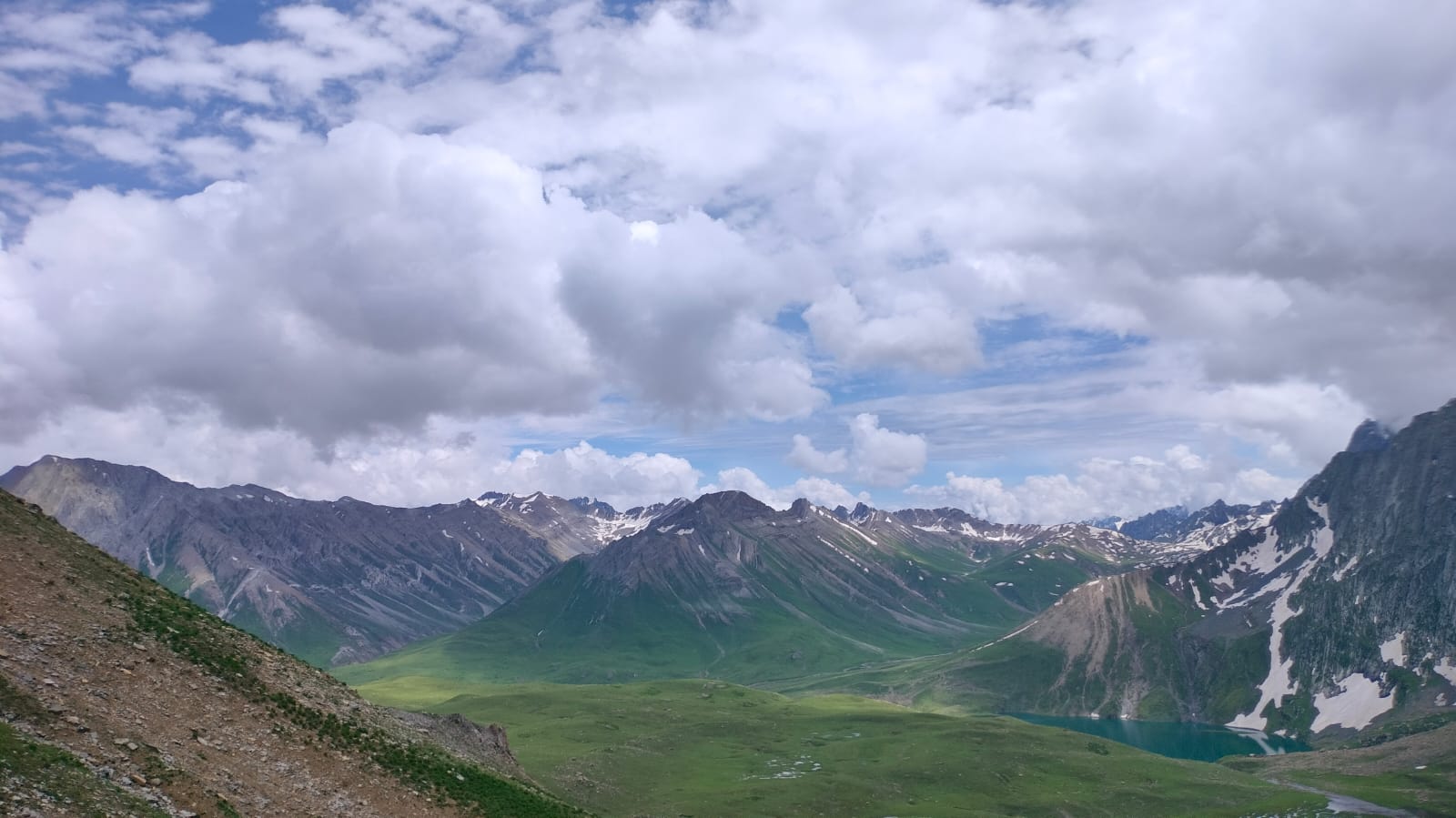
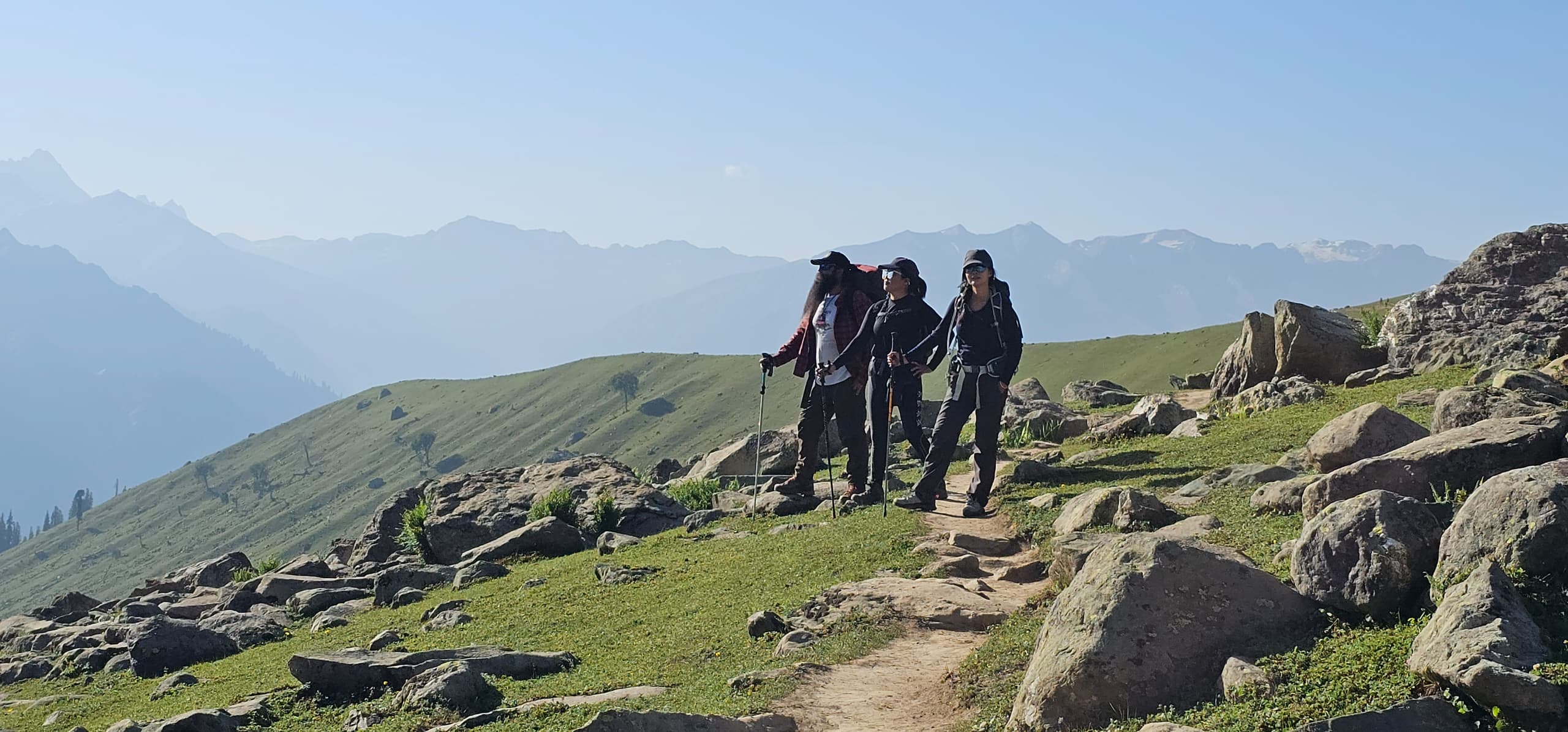
Over seven days, the route moves from pine forests and grazing valleys near Sonamarg to cold alpine passes, rocky ridgelines, glacier-fed lakes, and wide meadows spread across the higher Kashmir Himalayas.
The trek connects some of the most beautiful alpine lakes in Kashmir, including:
Unlike many Himalayan treks where the landscape begins feeling repetitive after a few days, KGL keeps changing continuously throughout the journey.
One day passes through maple and pine forests beside flowing rivers. Another opens into wide grasslands beneath snow-covered ridges. Higher sections near Gadsar Pass and Zaj Pass feel colder, quieter, and more rugged compared to the lower valleys.
For many trekkers, Kashmir Great Lakes is not remembered only because of its lakes, but because every day on the trail feels visually different from the last.
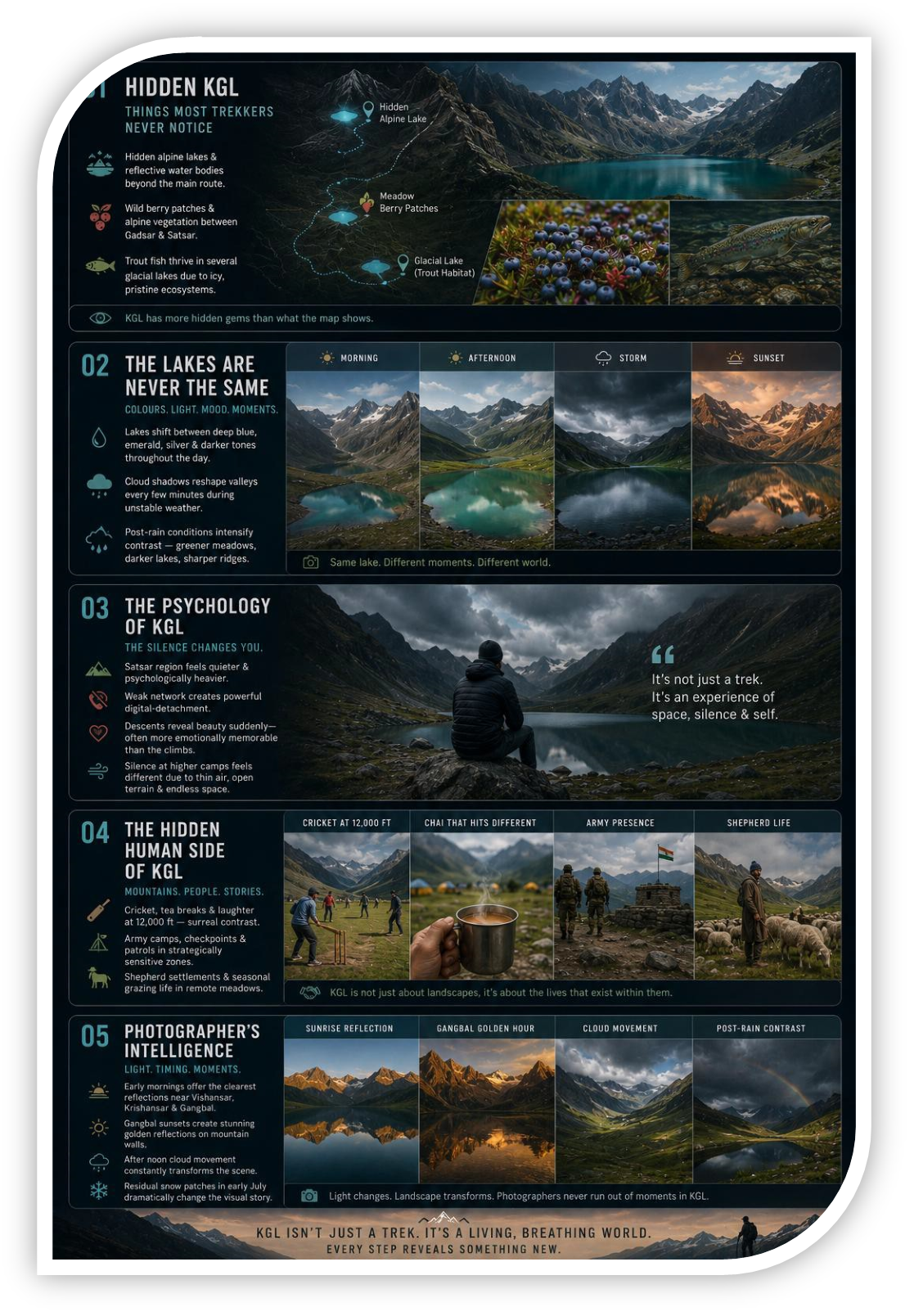
The Kashmir Great Lakes Trek is widely considered one of the most scenic treks in India because of the number of alpine lakes visible during a single route.
Within one trek, trekkers cross multiple lake systems connected through mountain passes, meadows, and glacial valleys.
The route also changes dramatically across the journey:
• lower sections contain pine forests and riverside trails,
• mid-altitude valleys open into large grasslands,
• while higher regions near Gadsar Pass become rockier and more exposed.
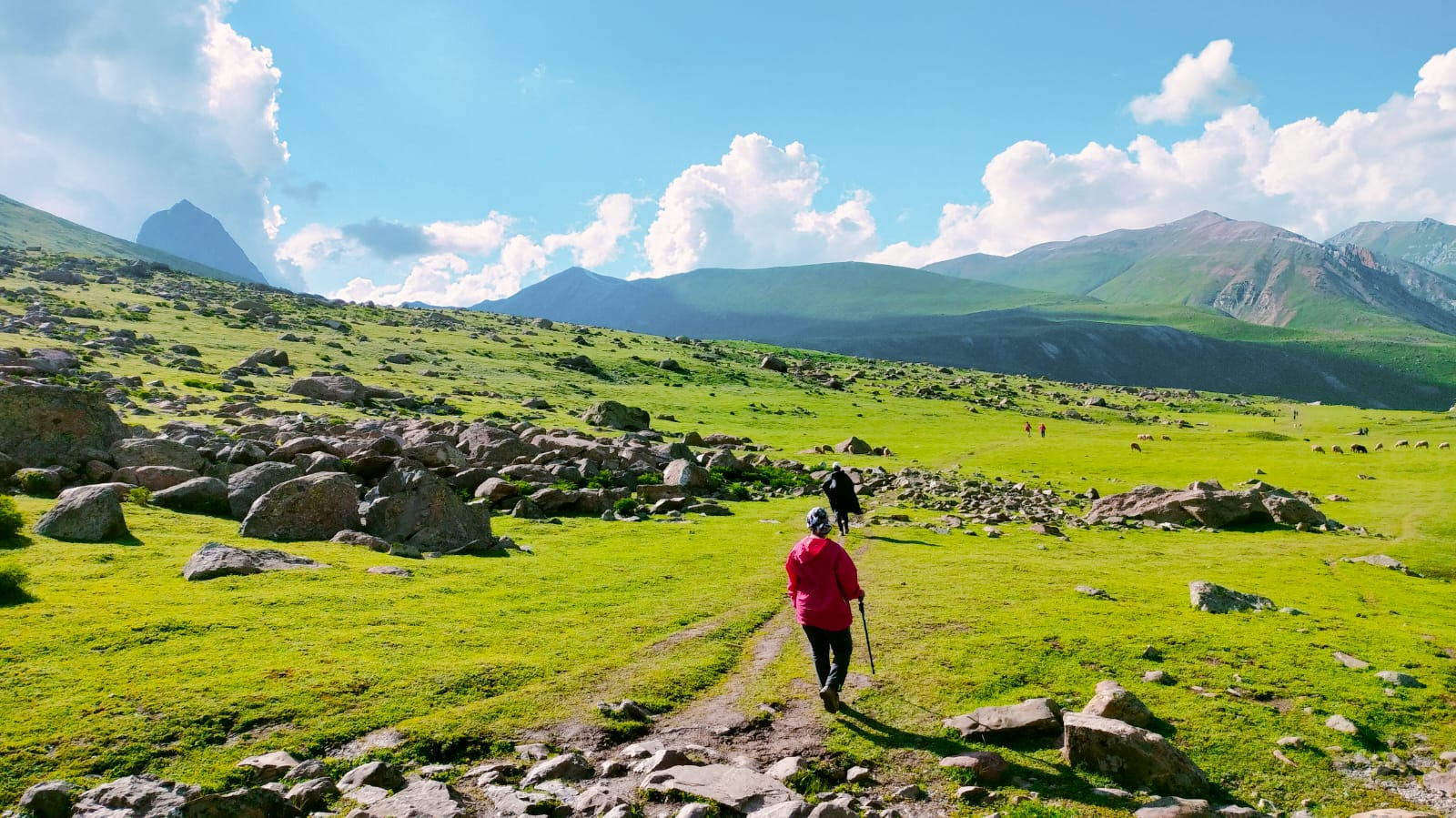
During July and August, several sections remain filled with wildflowers, flowing streams, and grazing sheep brought into the valleys by Gujjar and Bakarwal shepherd communities.
The trek also feels unusually expansive compared to many forest-heavy Himalayan routes. Large portions of the trail open into wide valleys where mountain ridges remain visible for hours while trekking.
Small experiences often become some of the strongest memories:
• morning reflections near Vishansar,
• mist moving across Gangbal Lake,
• tea after cold rain,
• damp shoes drying outside tents,
• and distant sheep bells echoing across the valleys.
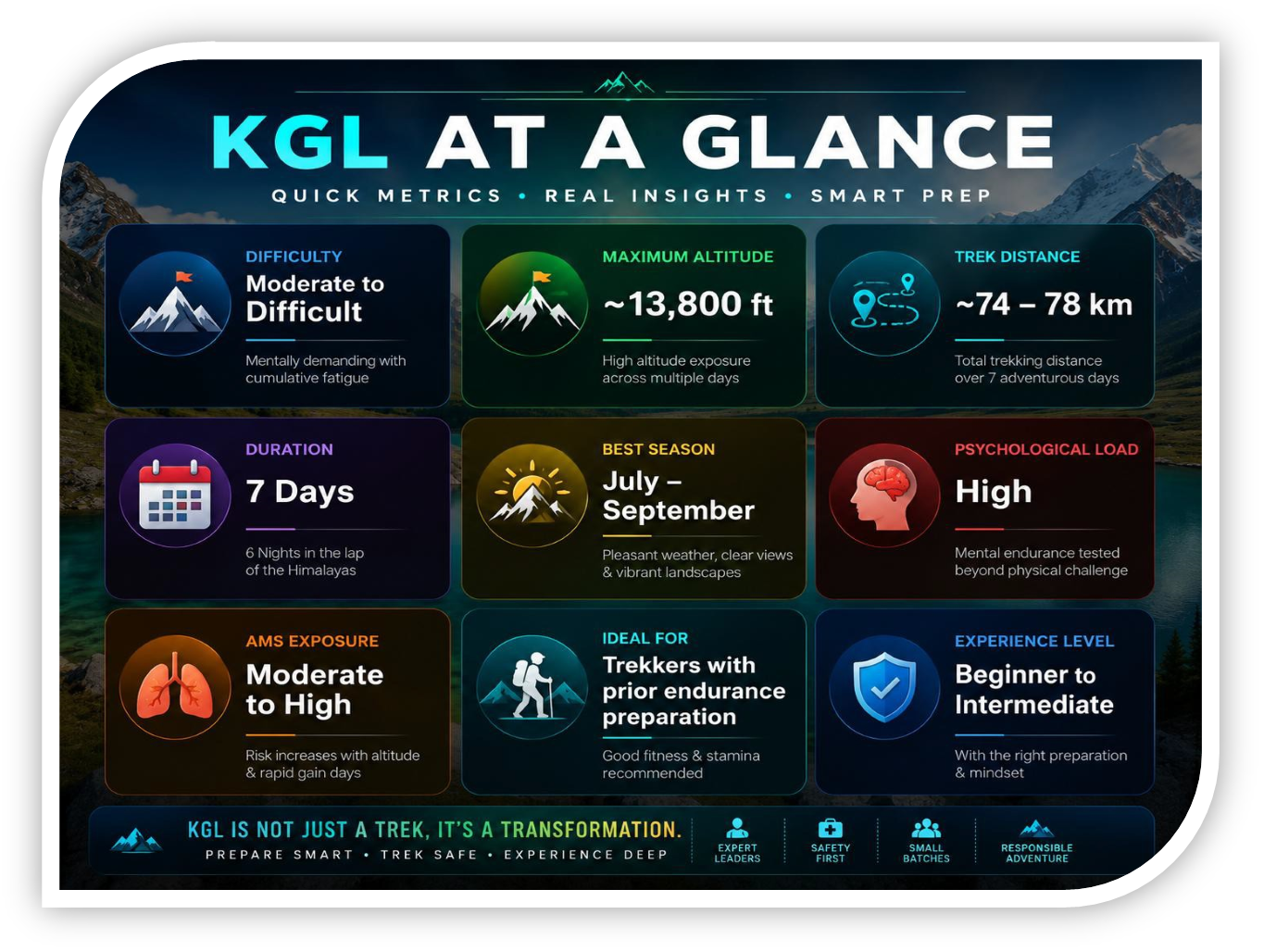
Kashmir Great Lakes Trek Difficulty
The Kashmir Great Lakes Trek is rated moderate to difficult mainly because of:
• long trekking days,
• high-altitude terrain,
• steep ascents near passes,
• and continuous walking over multiple days.
The trek does not require technical climbing or mountaineering experience, but trekkers should still prepare for:
• rocky sections,
• stream crossings,
• sudden weather shifts,
• cold nights,
• and thinner air above 12,000 ft.
The most demanding sections are usually:
• Nichnai Pass (~13,100 ft)
• Gadsar Pass (~13,800 ft)
• Zaj Pass (~13,000 ft)
Many trekkers expect the steep climbs to feel hardest. Surprisingly, several people feel more tired during the longer valley stretches after Day 4 because the walking becomes continuous even when the terrain looks easier.
Appetite also changes for some trekkers after crossing higher campsites. Eating smaller but regular meals and staying hydrated usually helps maintain energy during the later stages of the trek.
With proper preparation and steady pacing, fit beginners are generally able to complete the trek successfully.
The ThinAirExpedition team emphasized on health, hydration and acclimatization to altitude- something that was ignored frequently in the Himalayas. They even provided child-friendly rules and conditions of first-time visitors to the trek. Their premise and tone is what caught my eye most: soft but not quite aggressively, as a friend and a mentor who knows the mountains more than you do, but which desires you to discover a niche among the Himalayas.
The ThinAirExpedition team emphasized on health, hydration and acclimatization to altitude- something that was ignored frequently in the Himalayas. They even provided child-friendly rules and conditions of first-time visitors to the trek. Their premise and tone is what caught my eye most: soft but not quite aggressively, as a friend and a mentor who knows the mountains more than you do, but which desires you to discover a niche among the Himalayas.
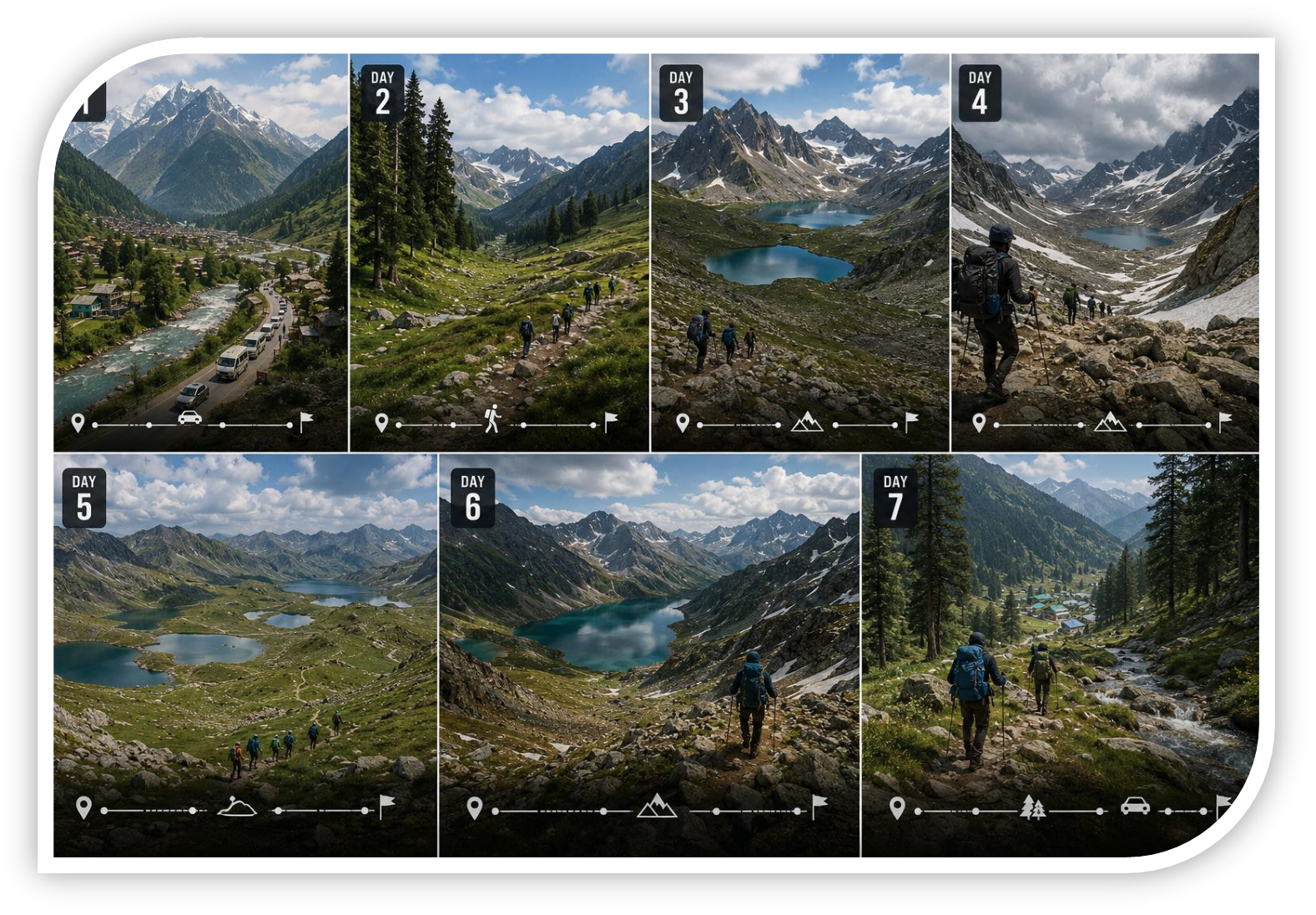
Day 1: Drive from Srinagar to Shitkadi Camp (Sonamarg)
Day 2: Trek from Shitkadi to Nichnai Camp
Day 3: Trek from Nichnai to Vishansar & Krishansar Lakes via Nichnai Pass
Day 4: Trek from Vishansar to Gadsar Lake via Gadsar Pass
Day 5: Trek from Gadsar to Satsar Lakes
Day 6: Trek from Satsar to Gangbal & Nandkol Lakes via Zaj Pass
Day 7: Trek from Gangbal to Naranag and drive back to Srinagar
The best season for the Kashmir Great Lakes Trek is from July to September.
The Kashmir Summer Trek opens in the month of June and stays open till the mid of September. In India, June is the month of vacation and most of the bookings are made for the same month. If you are one of those who wish to visit Kashmir in this season then, Tulian Lake, Pir Panjal, and Tosa Maidan start opening where meadows are still carry snow patches.
However, the peak season to visit Kashmir in summer when wildflowers bloom and charm of alpine lakes is at their best is July–August. Witness high-altitude lakes by visiting KGL Trek, Tarsar Marsar, Gangbal, Nafran Valley. Camping near the lake under the starry night is what most dream of and thin Air Expedition promises to make your wish come true.
If due to some reason you are not able to book your trek in the pea season then don’t worry. Late summer is also a good time to book your trek. In September the skies are crisp, meadows are gleaming golden, and best thing trails are less crowded. You can pick from two best treks for this season-Warwan Valley (famous for its long tails) and Nafran.
We know this information is not enough and sparks the need of more details. It is time to breakdown Treks one by one
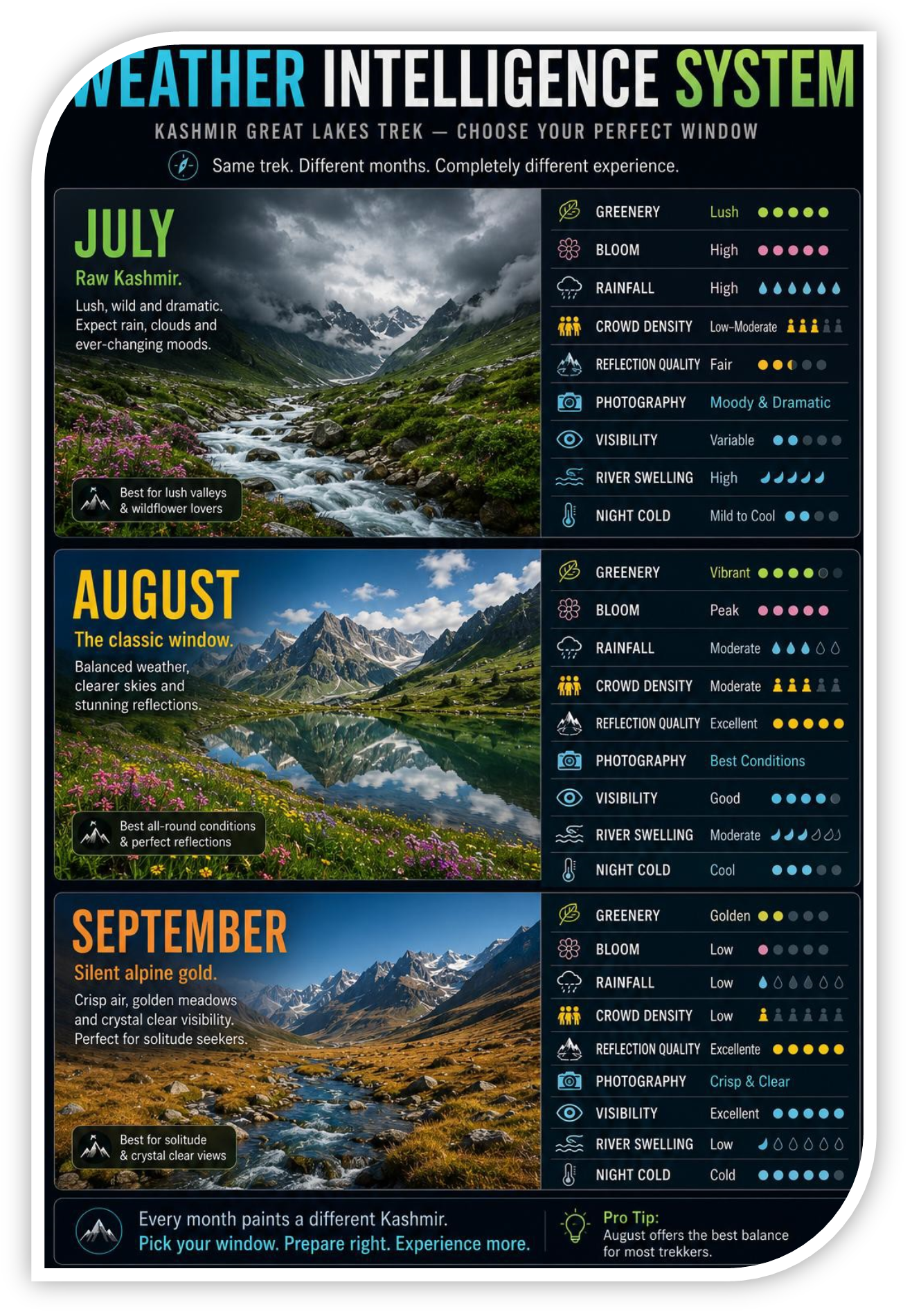
July
• Snow patches remain near higher passes
• Valleys turn greener after snowmelt
• Streams remain strong and cold
• Nights stay colder compared to later months
August
• Peak greenery across the meadows
• Wildflowers bloom heavily across several valleys
• Lakes usually appear clearer during stable weather
• One of the best months for photography
September
• Cleaner mountain visibility
• Fewer trekkers on the route
• Colder mornings and evenings
• Grasslands slowly begin turning golden
Weather conditions in Kashmir can still change quickly during all trekking months, especially near exposed sections around Nichnai Pass and Gadsar Pass.
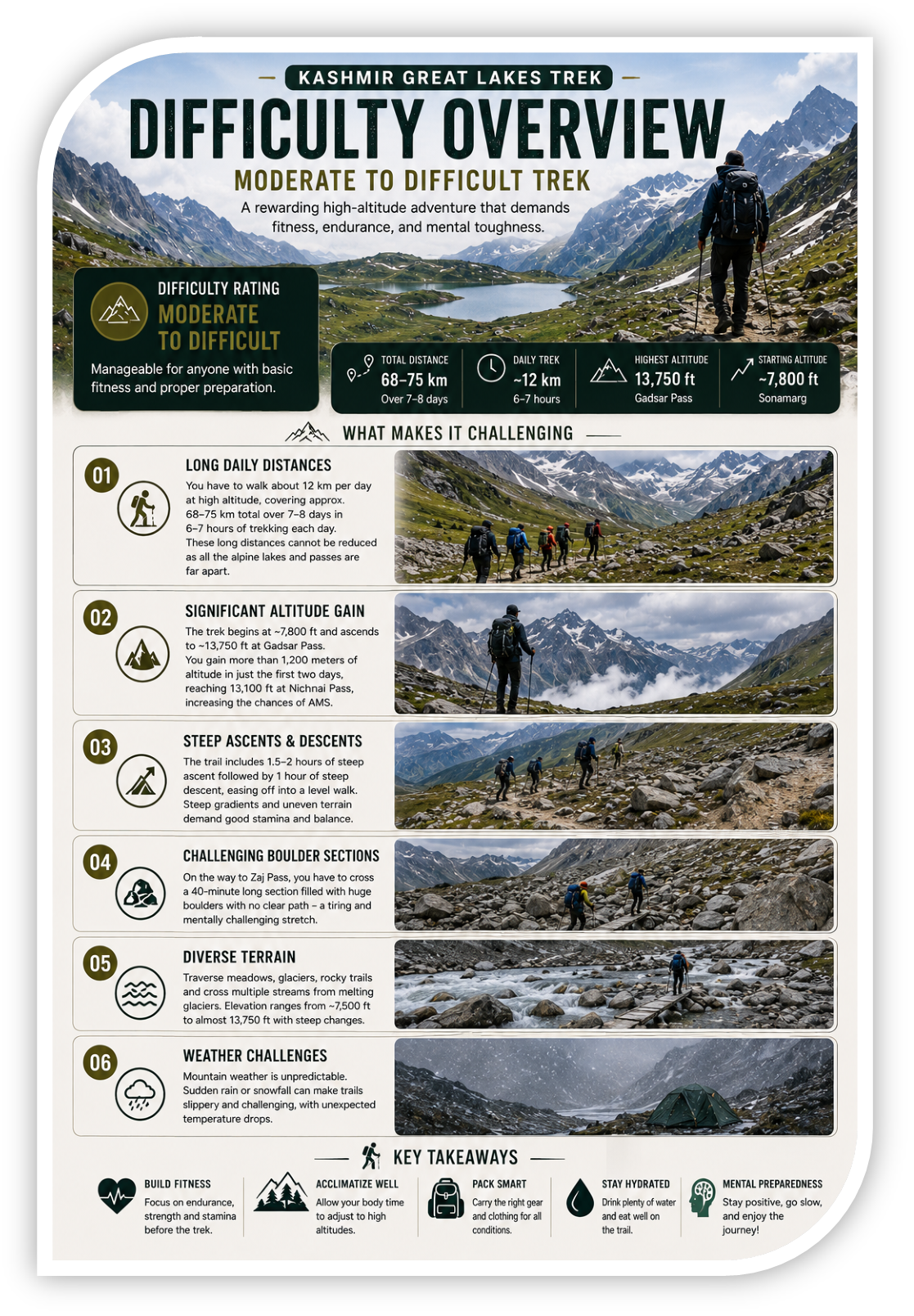
The Kashmir Great Lakes Trek is rated as moderate to difficult, making it one of the more challenging treks in Kashmir. Here's what you need to know about its difficulty:
Difficulty Rating
The trek is moderate to difficult level, making it slightly challenging but manageable for anyone with basic fitness and preparation. It's a moderate-difficult trek offering majestic views of alpine lakes, glaciers, meadows, peaks, and passes .
What Makes It Challenging
Long Daily Distances: You have to walk about 12 km per day at high altitude, covering approximately 68-75 km total over 7-8 days in 6-7 hours of trekking each day . These long distances cannot be reduced because all the alpine lakes are located at a certain distance from each other and the passes require almost a full day of hiking to cross .
Significant Altitude Gain: The trek begins at around 7,800 feet in Sonamarg and ascends to approximately 13,750 feet at Gadsar Pass, with trekkers gaining more than 1,200 meters of altitude in just the first two days. The trail takes you to 13,100 feet at Nichnai Pass on the second day itself, which increases the chances of AMS more than acclimatization allows.
Steep Ascents and Descents: The trek gradient includes 1.5-2 hours of steep ascent followed by 1 hour of steep descent, easing off into a level walk . The terrain includes steep ascents and descents, rocky sections, and uneven paths.
Challenging Boulder Sections: On the way to Zaj Pass, you have to cross a 40-minute long section filled with huge boulders with no path, creating a great challenge that can be tiring for some trekkers .
Diverse Terrain: You will traverse beautiful meadows, glaciers, and rocky trails, all while tackling steep elevation changes from approximately 7,500 feet to almost 13,750 feet. Trekkers will need to navigate across multiple streams resulting from melting glaciers, which can be quite tricky .
Weather Challenges: Mountain weather can be unpredictable with sudden rain or snowfall making the trails slippery and challenging, with unexpected weather changes causing temperature drops
The Kashmir Great Lakes Trek is rated as moderate to difficult, making it one of the more challenging treks in Kashmir. Here's what you need to know about its difficulty:
Difficulty Rating
The trek is moderate to difficult level, making it slightly challenging but manageable for anyone with basic fitness and preparation. It's a moderate-difficult trek offering majestic views of alpine lakes, glaciers, meadows, peaks, and passes .
What Makes It Challenging
Long Daily Distances: You have to walk about 12 km per day at high altitude, covering approximately 68-75 km total over 7-8 days in 6-7 hours of trekking each day . These long distances cannot be reduced because all the alpine lakes are located at a certain distance from each other and the passes require almost a full day of hiking to cross .
Significant Altitude Gain: The trek begins at around 7,800 feet in Sonamarg and ascends to approximately 13,750 feet at Gadsar Pass, with trekkers gaining more than 1,200 meters of altitude in just the first two days. The trail takes you to 13,100 feet at Nichnai Pass on the second day itself, which increases the chances of AMS more than acclimatization allows.
Steep Ascents and Descents: The trek gradient includes 1.5-2 hours of steep ascent followed by 1 hour of steep descent, easing off into a level walk . The terrain includes steep ascents and descents, rocky sections, and uneven paths.
Challenging Boulder Sections: On the way to Zaj Pass, you have to cross a 40-minute long section filled with huge boulders with no path, creating a great challenge that can be tiring for some trekkers .
Diverse Terrain: You will traverse beautiful meadows, glaciers, and rocky trails, all while tackling steep elevation changes from approximately 7,500 feet to almost 13,750 feet. Trekkers will need to navigate across multiple streams resulting from melting glaciers, which can be quite tricky .
Weather Challenges: Mountain weather can be unpredictable with sudden rain or snowfall making the trails slippery and challenging, with unexpected weather changes causing temperature drops
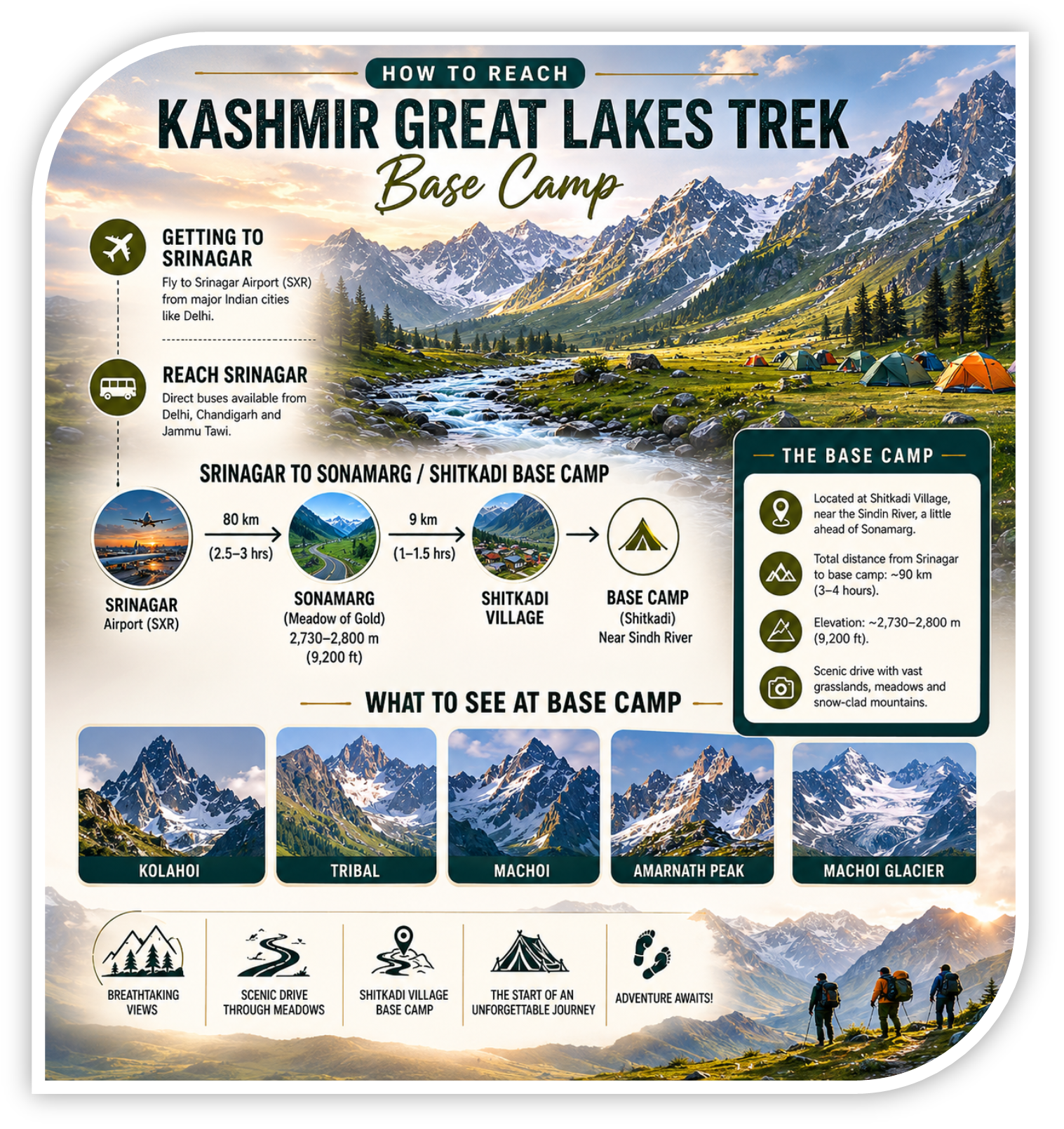
How To Reach Kashmir Great Lakes Trek BaseCamp
Here's how to reach the Kashmir Great Lakes trek base camp:
Getting to Srinagar
Most trekkers fly into Srinagar Airport (SXR), which receives flights from major Indian cities including Delhi . You can also reach Srinagar by bus, as there are direct buses from Delhi, Chandigarh, and Jammu Tawi .
Srinagar to Sonamarg/Shitkadi Base Camp
Distance & Time: Sonamarg is 80 km away from Srinagar and can be reached by taxi or bus in approximately 2.5-3 hours . The trek base camp is at Shitkadi, which is 9 kilometers from Sonamarg, taking about 3-4 hours total from Srinagar.
The Base Camp Location
The base camp is at Shitkadi Village, located near the Sindh River, a little ahead of Sonamarg . Sonamarg, which translates to Meadow of Gold, sits at an elevation of around 2,730-2,800 meters (9,200 feet) .
What to See at Base Camp
From the base camp you can spot great mountain peaks like Kolahoi, Tribal, Machoi, Amarnath Peak, and Machoi Glacier. The view en route is very scenic with vast expanses of grasslands and meadows on either side of the road.
Here's how to reach the Kashmir Great Lakes trek base camp:
Getting to Srinagar
Most trekkers fly into Srinagar Airport (SXR), which receives flights from major Indian cities including Delhi . You can also reach Srinagar by bus, as there are direct buses from Delhi, Chandigarh, and Jammu Tawi .
Srinagar to Sonamarg/Shitkadi Base Camp
Distance & Time: Sonamarg is 80 km away from Srinagar and can be reached by taxi or bus in approximately 2.5-3 hours . The trek base camp is at Shitkadi, which is 9 kilometers from Sonamarg, taking about 3-4 hours total from Srinagar.
The Base Camp Location
The base camp is at Shitkadi Village, located near the Sindh River, a little ahead of Sonamarg . Sonamarg, which translates to Meadow of Gold, sits at an elevation of around 2,730-2,800 meters (9,200 feet) .
What to See at Base Camp
From the base camp you can spot great mountain peaks like Kolahoi, Tribal, Machoi, Amarnath Peak, and Machoi Glacier. The view en route is very scenic with vast expanses of grasslands and meadows on either side of the road.
Good rain protection becomes especially important during July and August because weather changes quickly around exposed mountain sections.
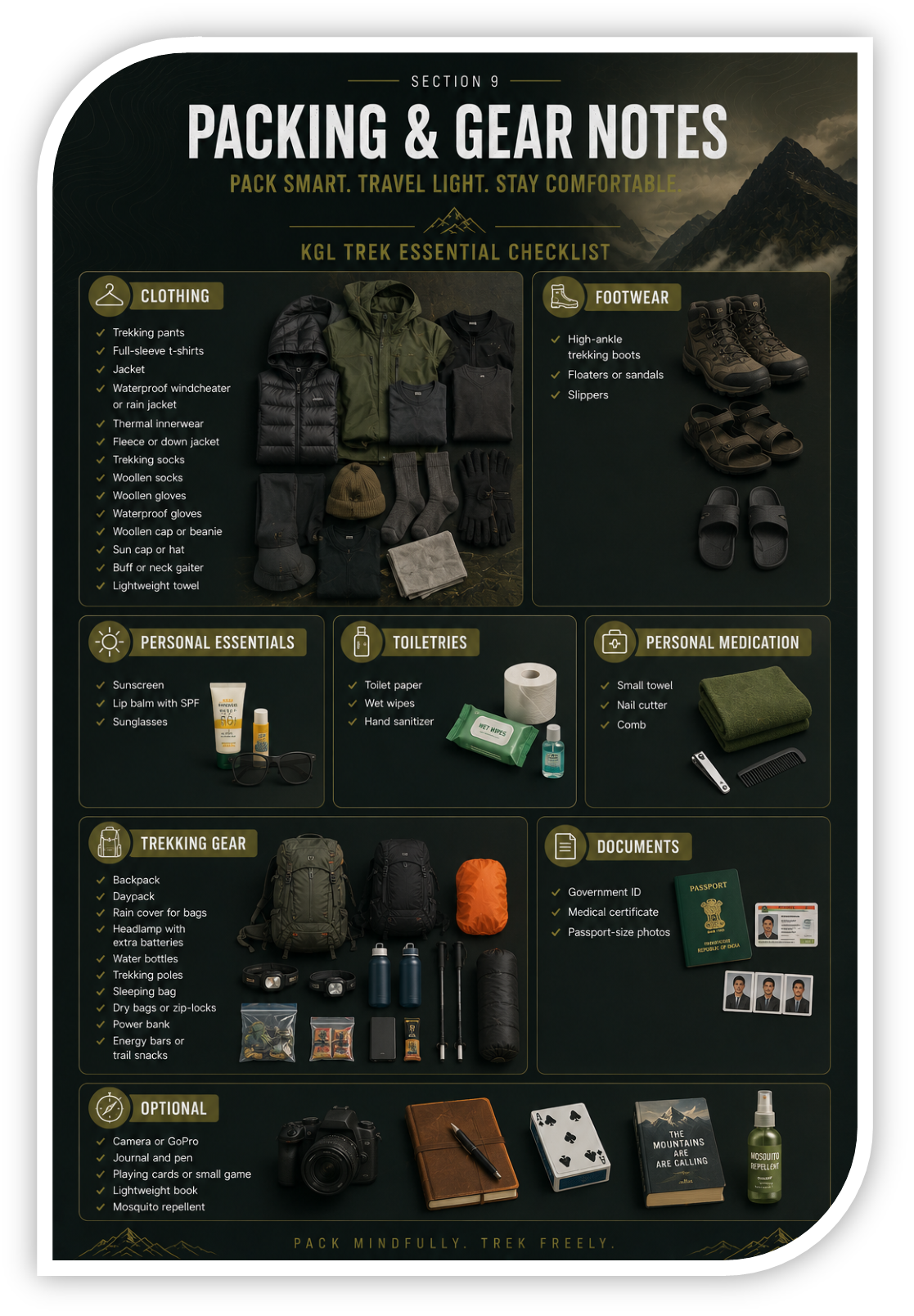
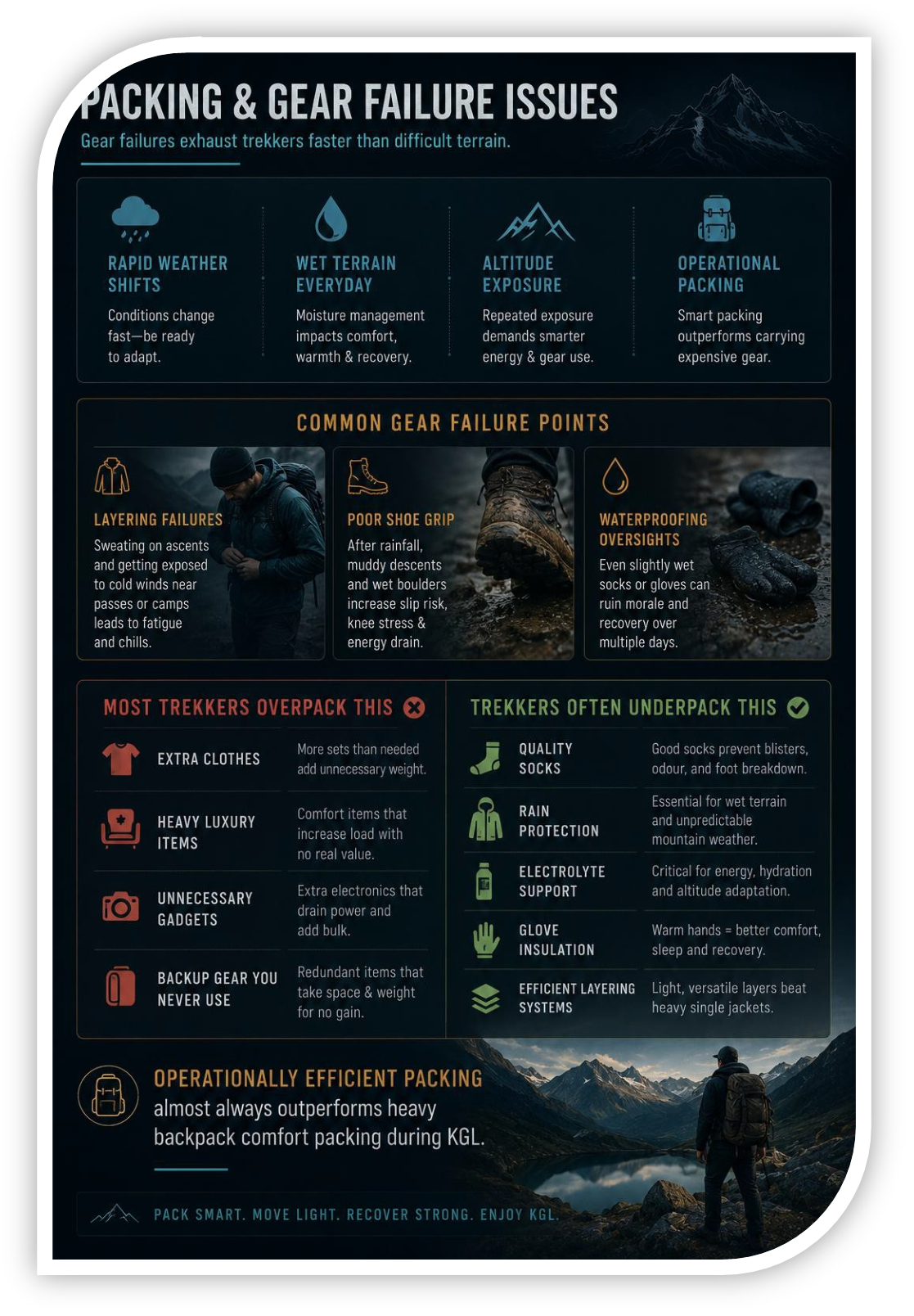
Gear failures exhaust trekkers faster than difficult terrain.
Most trekking gear problems during the Kashmir Great Lakes Trek happen because trekkers either overpack unnecessary items or underestimate weather exposure, moisture management, and recovery comfort. Rapidly shifting mountain weather, wet terrain, and repeated altitude exposure make operational packing far more important than carrying expensive gear.
Layering failures are especially common during long ascents where trekkers sweat heavily and later get exposed to cold winds near passes or campsites. Similarly, poor shoe grip becomes dangerous after rainfall when muddy descents and wet boulders reduce movement efficiency and increase knee stress. Waterproofing also becomes critical because even partially wet socks or gloves can drastically reduce morale and recovery quality over consecutive trekking days.
Most Trekkers Overpack THIS and Underpack THAT
Trekkers commonly overpack:
• extra clothes,
• heavy luxury items,
• unnecessary gadgets,
• and backup gear they never use.
At the same time, they often underpack:
• quality socks,
• rain protection,
• electrolyte support,
• glove insulation,
• and efficient layering systems.
Operationally efficient packing almost always outperforms heavy backpack comfort packing during KGL.
Trekking permits for KGL are usually arranged by the trek organizer.
These generally include:
Trekkers should carry:
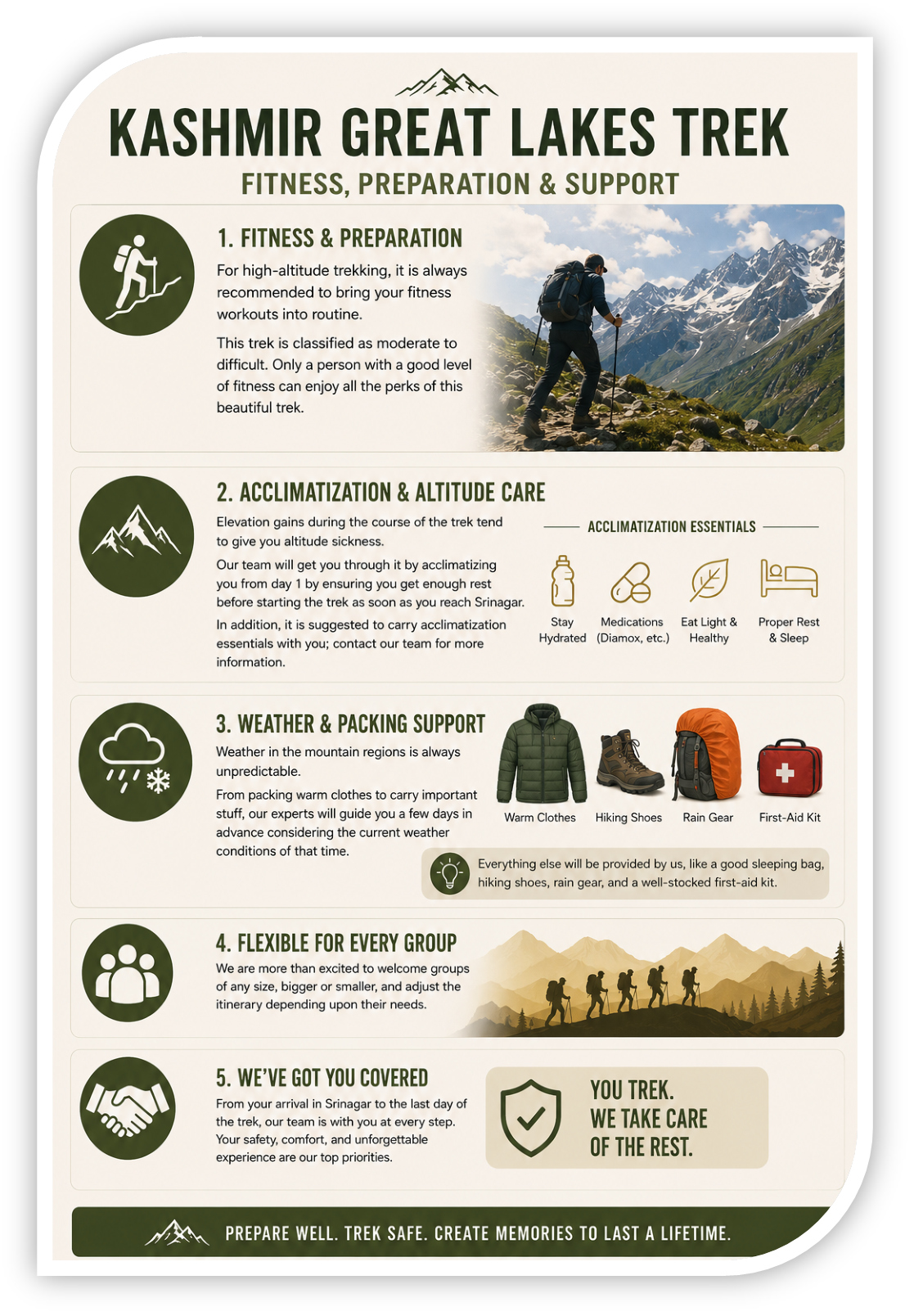
For high-altitude trekking, it is always recommended to bring your fitness workouts into routine. This trek is classified as moderate to difficult. Only a person with a good level of fitness can enjoy all the perks of this beautiful trek.
Elevation gains during the course of the trek tend to give you altitude sickness. Our team will get you through it by acclimatizing you from day 1 by ensuring you get enough rest before starting the trek as soon as you reach Srinagar. In addition, it is suggested to carry acclimatization essentials with you; contact our team for more information.
Weather in the mountain regions is always unpredictable. From packing warm clothes to carry important stuff, our experts will guide you a few days in advance considering the current weather conditions of that time. Everything else will be provided by us, like a good sleeping bag, hiking shoes, rain gear, and a well-stocked first-aid kit.
We are more than excited to welcome groups of any size, bigger or smaller, and adjust the itinerary depending upon their needs.
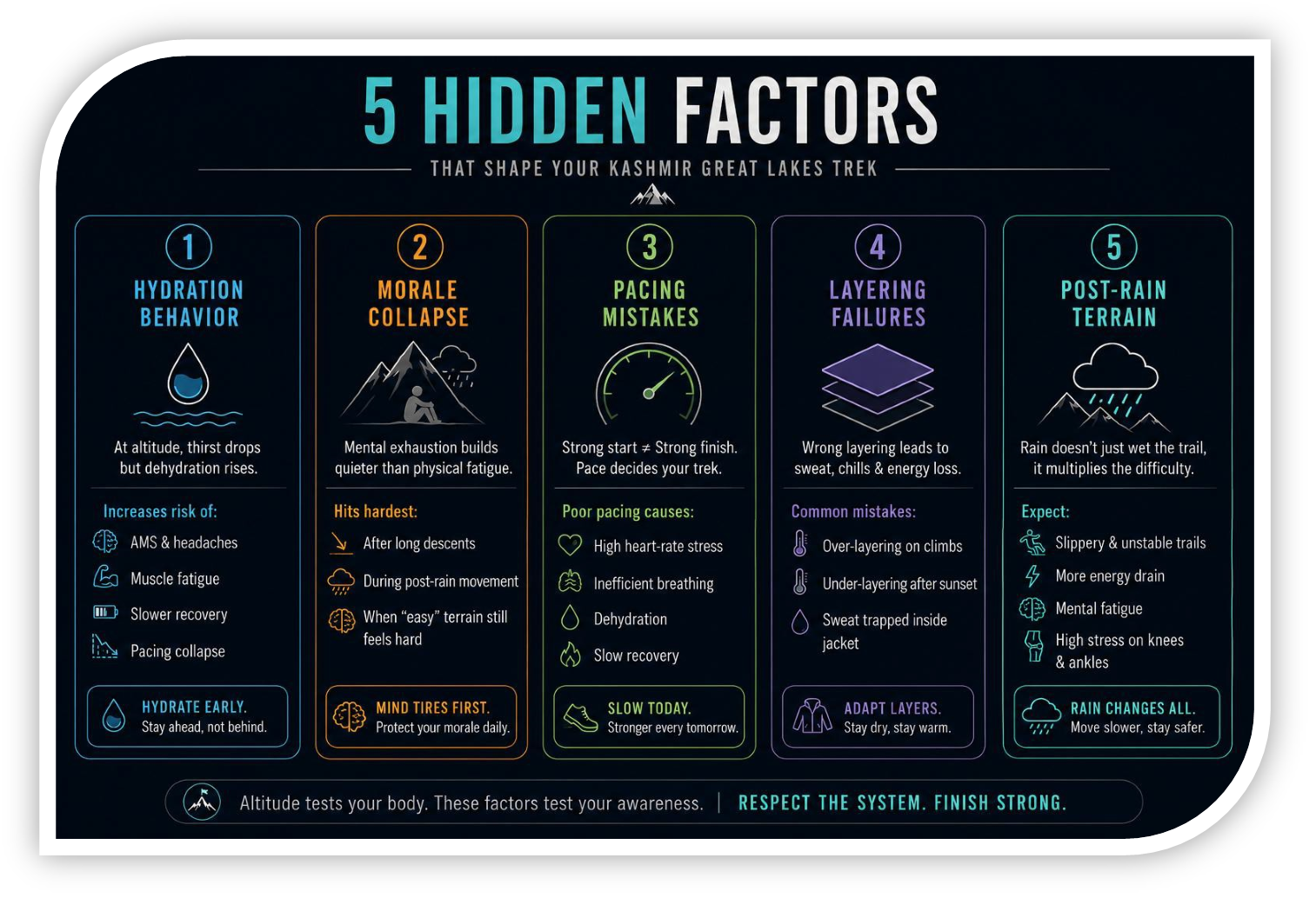
1. HYDRATION BEHAVIOR
(Huge, overlooked factor)
One of the most underestimated problems during the Kashmir Great Lakes Trek is not lack of fitness — it is gradual dehydration accumulation over consecutive trekking days. At altitude, trekkers often feel less thirsty despite continuously losing fluids through breathing, sweat evaporation, and dry mountain air.
Many trekkers unknowingly begin drinking less water after Day 3 because:
This becomes dangerous because dehydration directly increases:
Real Field Pattern
Experienced trek leaders often observe that trekkers who hydrate aggressively on Day 1 and Day 2 usually recover significantly better near Gadsar and Satsar compared to trekkers who drink “only when thirsty.”
2. MORALE COLLAPSE
The Kashmir Great Lakes Trek is rarely technically dangerous, but morale deterioration becomes surprisingly common after repeated high-altitude trekking days. Most trekkers expect physical tiredness. What they do not anticipate is the gradual mental exhaustion caused by:
Morale usually drops hardest:
Many trekkers mentally struggle more after reaching camp than during actual climbs because the body stops generating adrenaline once movement ends and cold exposure increases.
3. PACING MISTAKES
(Massive beginner failure pattern)
One of the most common reasons trekkers struggles during KGL is poor pacing strategy during the first two days. Many beginners aggressively climb early sections while energy reserves are still high, unknowingly accelerating fatigue accumulation for later stages of the expedition.
Poor pacing creates:
Trekkers who appear strongest on Day 2 are not always strongest by Day 5. Controlled pacing consistently outperforms aggressive movement during multi-day Himalayan trekking.
LAYERING FAILURES
Layering mistakes become extremely common during the Kashmir Great Lakes Trek because weather changes rapidly between:
• direct sunlight,
• windy ridgelines,
• rain exposure,
• and cold evening conditions.
Most beginners either:
• over-layer during climbs and sweat excessively,
OR
• under-layer after sunset and lose body heat rapidly.
Sweat accumulation inside jackets becomes especially dangerous after crossing passes because wet inner layers dramatically increase cold stress during rest stops.
Realistic Field Note
Trekkers frequently remove outer layers too early during sunny ascents and later struggle with rapid temperature drops once cloud cover and wind exposure increase.
4. POST-RAIN TERRAIN BEHAVIOR
(Strong information gain)
Rain changes the behaviour of the Kashmir Great Lakes Trek far more than most itinerary pages mention. Trails that appear stable in dry conditions become:
• slippery,
• energy-draining,
• mentally slower,
• and significantly more exhausting after rainfall.
Wet grass sections increase friction fatigue while muddy descents create constant micro-adjustments that heavily stress knees and ankles over long durations.
High-Altitude Reality Even moderate rain exposure can psychologically exhaust trekkers faster than steep climbs because movement efficiency drops while cold stress increases simultaneously.
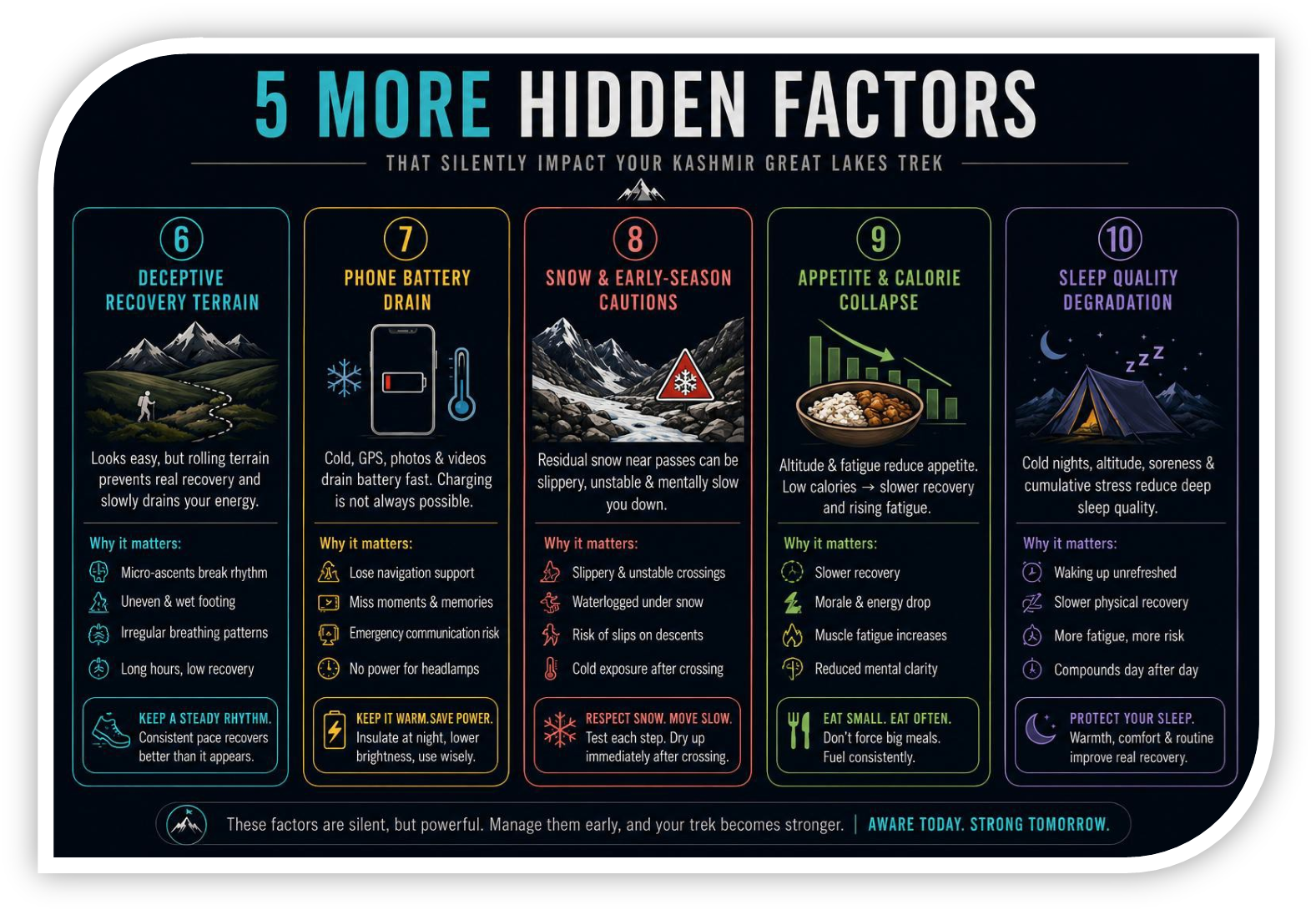
5.DECEPTIVE RECOVERY TERRAIN
Some sections of the Kashmir Great Lakes Trek visually appear “easy” but become deceptively exhausting because the terrain prevents proper recovery despite lower gradients.
Rolling terrain near sections like Satsar continuously interrupts pacing rhythm through:
• repeated micro-ascents,
• uneven footing.
• wet patches
• and irregular breathing patterns.
Trekkers expect recovery terrain after difficult passes but instead encounter slow cumulative energy drain over several hours.
Operational Insight
The body recovers best during consistent rhythm movement. Constant terrain interruptions reduce recovery efficiency even when the terrain does not appear technically difficult.
6.PHONE BATTERY DRAIN
Cold temperatures and inconsistent charging opportunities make phone battery management a surprisingly important issue during the Kashmir Great Lakes Trek. Batteries drain significantly faster at high altitude, especially during:
• cold mornings,
• windy camps,
• heavy camera usage,
• GPS tracking,
• and continuous video recording.
Many trekkers unknowingly waste battery early in the expedition and later lose:
• navigation support,
• photography opportunities,
• emergency communication,
• and power for headlamps or backup devices.
Common Mistakes
• sleeping with phones outside sleeping bags
• excessive drone/video usage
• using brightness at maximum during daylight
• relying on weak power banks
Operational Recommendation
Experienced trekkers often keep phones and batteries insulated inside jackets or sleeping bags during the night to reduce cold-related battery degradation.
7. SNOW & EARLY-SEASON CAUTIONS
(Huge search relevance)
During early July batches, residual snow patches near high passes like Nichnai Pass and Gadsar Pass can significantly alter trekking conditions. Even when snow looks visually manageable, partially melted sections often become:
• unstable,
• slippery,
• waterlogged underneath,
• and mentally slow to cross.
Trekkers unfamiliar with snow movement frequently:
• overstep aggressively,
• lose footing during descents,
• or underestimate cold exposure after snow crossings.
Important Reality
Snow sections themselves are usually not the biggest issue. Wet shoes, reduced pace efficiency, and prolonged cold exposure afterward create much larger fatigue problems over time.
8.APPETITE & CALORIE COLLAPSE
Many trekkers begin eating less food after Day 3 because altitude and fatigue suppress appetite. This creates a dangerous recovery cycle where the body receives insufficient calories despite continuously increasing energy expenditure.
Low calorie intake directly contributes to:
• slower recovery,
• morale collapse,
• muscular fatigue,
• cold sensitivity,
• and reduced mental clarity.
Common Pattern
Trekkers often mistake exhaustion for “normal tiredness” when the actual problem is sustained calorie deficit combined with dehydration and altitude exposure.
9. SLEEP QUALITY DEGRADATION
Sleep quality gradually declines during consecutive high-altitude trekking days due to:
• colder nights,
• breathing irregularities,
• muscle soreness,
• wet gear,
• noise inside camps,
• and cumulative exhaustion.
Many trekkers technically sleep for several hours but wake up feeling poorly recovered because altitude reduces sleep efficiency significantly.
Operational Insight
Recovery failure compounds quietly during KGL. Trekkers often do not notice degraded sleep quality until fatigue sharply peaks near later stages of the expedition.
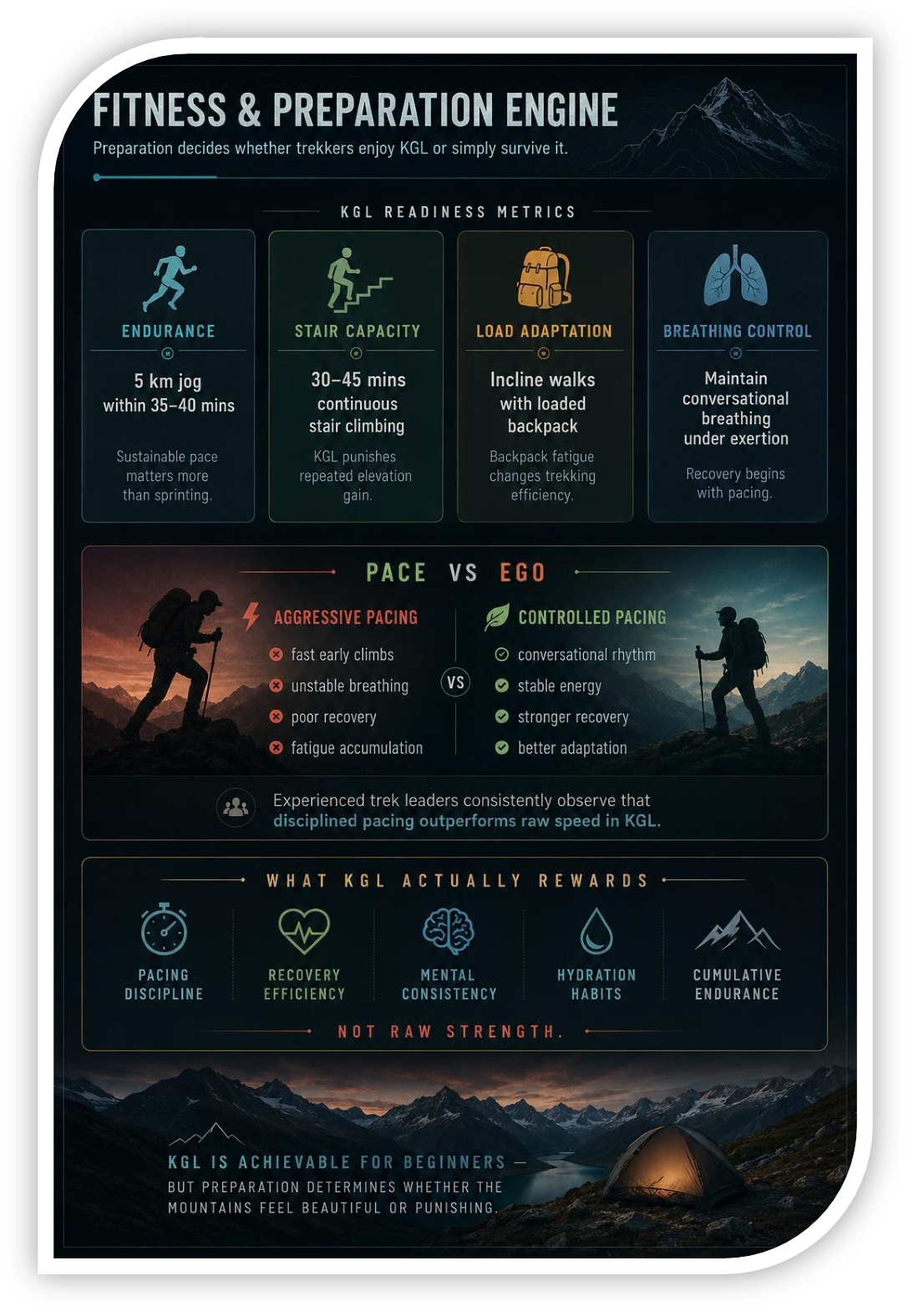
Preparation decides whether trekkers enjoy KGL or simply survive it.
The Kashmir Great Lakes Trek is not technically extreme, but repeated pass crossings, long descents, altitude exposure, and cumulative fatigue make preparation critical. Most trekkers who struggle during KGL are not necessarily “unfit” — they are simply underprepared for consecutive high-altitude trekking days. A realistic preparation system should focus on endurance, pacing, recovery, stair training, and backpack adaptation rather than only gym strength.
Trekkers should ideally be comfortable with:
• a 5 km jog within 35–40 minutes,
• continuous stair climbing for 30–45 minutes,
• carrying a loaded backpack during incline walks,
• and maintaining steady breathing under prolonged exertion.
One of the biggest beginner mistakes is aggressive pacing during the first two trekking days. Experienced trek leaders repeatedly observe that trekkers who maintain conversational breathing rhythms recover far better near Gadsar and Satsar compared to trekkers who push too hard early in the expedition.
Can You Do KGL?
KGL is achievable for beginners with disciplined preparation, but the trek becomes significantly more manageable for trekkers who already have:
• consistent cardio training,
• decent recovery capacity,
• prior hiking exposure,
• and basic load-carrying endurance.
The trek rewards pacing discipline far more than raw speed or gym strength.
Transport
Pickup & drop from Srinagar (pickup time: approx. 11:30 AM)
Comfortable vehicle SUV / Bolero / Tavera / Ertiga or a similar vehicle, depending on group size and availability.
Driver and vehicle details shared one day prior
Accommodation (On Trek)
Twin-sharing high-quality tents (A-Shape /Vango / The North Face / Mountain Hardwear or similar)
Sleeping bags rated up to -10°C
Foam mattresses
Meals
From Day 1 Dinner to Day 7 Breakfast
Nutritious veg with (eggs)
Breakfast, packed lunch, evening snacks, Soup, and dinner
Camping & Facilities
Kitchen and dining tent with tables & chair/Stools
Camp lighting
Toilet tent with portable western seat
Safety & Equipment
Microspikes, gaiters, helmets, ice axe (if required)
Oxygen cylinders and comprehensive medical kit
Team trained in high-altitude first aid
Permits & Fees
All forest permits and camping charges included
(Additional charges for foreign nationals)
Support Team
Certified Trek Leader (NIM/AMC/BMC trained)
Local guides
Cook, helpers, and support staff
Mules/porters for common equipment
Personal expenses (tips, medicines, phone calls, etc.)
Travel to Srinagar
Backpack offloading Charges INR 500 Per day per bag (1 bag per person up to 10–12 kg)
Personal trekking gear
Trek insurance (mandatory)
Buffer day cost (if used)
Anything not mentioned in inclusions
Ideally, the trekking window opens from mid-June to mid-September. Meadows are in the full bloom as snow starts to melt. And lakes are finally accessible. And that is why trekkers come-for the 7 lakes trek.
The best time is from July to September. During these months, the weather is stable, snow has melted, and the meadows and alpine lakes are at their most scenic.
It is a moderate to difficult trek. Expect long walking hours, steep ascents, and high-altitude passes. Good fitness and stamina are required.
The trek is around 70–75 km long and usually completed in 7 days, with daily walks of 6–8 hours.
Yes, a trekking permit is required as the route passes through regulated areas. Most registered trek operators arrange it.
The highest point is Gadsar Pass at approximately 13,750 ft (4,191 meters) above sea level.
The main lakes include Vishansar, Krishansar, Gadsar, Satsar, Nundkol, Gangbal, and Kishansar, depending on the route.
Start training 4–6 weeks prior. Focus on cardio, leg strength, endurance exercises, and practice hikes with a backpack to build stamina.
Yes, fit beginners can attempt it with proper preparation. However, prior trekking experience is helpful due to its moderate difficulty.
Yes, it is generally safe when done with a certified operator, proper gear, and adequate preparation.
Mobile network is limited after the base camp. Charging points are usually unavailable, so carrying power banks is recommended.
Yes, fresh water is available from natural streams. It should be filtered or purified before drinking.
The Kashmir Great Lakes Trek is considered moderate to difficult because of repeated pass crossings,
long trekking days, altitude exposure, and cumulative fatigue over consecutive days rather than
technical climbing difficulty.
Yes, beginners with proper fitness preparation, endurance training, and pacing discipline can complete
the KGL trek successfully. Most beginner struggles come from poor preparation rather than terrain
difficulty.
Most trekkers find the Vishansar to Gadsar section via Gadsar Pass physically and mentally demanding
because cumulative fatigue peaks while altitude exposure and weather unpredictability increase
significantly.
The descents are often more exhausting than the climbs because long downhill sections continuously
stress knees, ankles, and recovery systems over multiple days.
No, KGL is not considered technically dangerous for prepared trekkers, but weather changes, slippery
terrain after rain, and fatigue accumulation require consistent pacing and caution.
The highest point of the trek is Gadsar Pass at approximately 13,750–13,800 ft.
Mild AMS symptoms like headaches, nausea, and fatigue are relatively common because trekkers spend
multiple consecutive days above 11,000 ft.
Hydration, slow pacing, electrolyte balance, proper sleep, and avoiding aggressive climbs during the first
two days significantly reduce AMS risk.
Recovery quality gradually decreases because of repeated altitude exposure, muscular fatigue,
inconsistent sleep, and cumulative energy depletion.
Trekkers usually notice heavier breathing and slower recovery near high passes and exposed sections
above 12,500 ft.
Trekkers should ideally be capable of:
• jogging 5 km comfortably,
• climbing stairs continuously for 30–45 minutes,
• and carrying a loaded backpack during long walks.
No. Endurance, recovery ability, pacing efficiency, and sustained cardio matter significantly more than
gym-based muscle strength.
Preparation should focus on:
• endurance walks,
• stair training,
• breathing control,
• recovery adaptation,
• and consistent cardio over several weeks.
Pacing is one of the biggest success factors in the Kashmir Great Lakes Trek. Trekkers who start too
aggressively usually struggle later near Gadsar and Satsar.
July to September is considered the best trekking season because snow gradually clears while alpine
lakes, meadows, and passes become accessible.
Night temperatures can drop close to freezing, especially near high-altitude camps and after rainfall.
Weather changes rapidly in Kashmir. Afternoon rain showers and post-rain cold exposure are relatively
common during July and August.
Rain significantly changes terrain behavior by making descents slippery, slowing movement efficiency,
increasing cold stress, and accelerating fatigue accumulation.
Residual snow patches are sometimes present during early July, especially near passes like Nichnai
Pass and Gadsar Pass.
Vishansar, Krishansar, Gangbal, and Gadsar Lakes are among the most photographed alpine lakes
during the trek
August usually offers the best combination of greenery, lake reflections, cloud formations, and stable
landscape visibility.
Drone usage may face restrictions depending on local regulations, security conditions, and weather
exposure in Kashmir.
Early mornings usually provide the calmest water conditions and strongest alpine lake reflections.
Although experienced trekkers occasionally attempt solo trekking, most people prefer organized trekking
groups because of logistics, weather unpredictability, navigation, and safety support.
Trail visibility can reduce significantly during fog, snowfall remnants, or rain exposure near passes and
open valleys.
The Kashmir Great Lakes Trek is generally considered safe for women trekkers, especially with
experienced trekking organizations and organized expedition groups.
Some trekking companies occasionally organize women-focused or women-led trekking groups during
peak season.
Basic temporary toilet tents are generally used during camping sections because this is a remote highaltitude expedition route.
Mobile connectivity is extremely limited. Some trekkers occasionally receive weak BSNL signals near
higher passes, but network access remains unreliable throughout most of the trekMobile connectivity is extremely limited. Some trekkers occasionally receive weak BSNL signals near
higher passes, but network access remains unreliable throughout most of the trek
Trekkers usually depend on power banks because charging access remains inconsistent at high-altitude
camps.
Cold temperatures, altitude exposure, GPS usage, and continuous photography significantly accelerate
battery drain during the trek.
Carrying at least one high-capacity power bank is strongly recommended for photography, emergency
communication, and navigation backup.
Most trekking groups provide high-carb vegetarian meals including rice, chapati, dal, soups, tea,
noodles, and energy snacks.
Yes, glacier-fed streams and alpine water sources are common, although purification is strongly
recommended.
Altitude exposure and cumulative fatigue often suppress hunger after Day 3, even though calorie
requirements increase significantly.
High-altitude camps can become extremely cold after sunset, especially during windy or rainy
conditions.
Many trekkers experience lighter sleep, interrupted breathing patterns, and slower recovery during
consecutive high-altitude nights.
Gangbal and Vishansar camps are frequently considered among the most visually dramatic campsites
of the expedition.
The Kashmir Great Lakes Trek includes:
• alpine meadows,
• rocky ascents,
• moraine sections,
• stream crossings,
• exposed ridgelines,
• and long descents.
Trekking poles are highly recommended because they reduce knee stress during descents and improve
stability on wet terrain.
Most stream crossings remain manageable during normal conditions, but water flow may increase after
rainfall.
Repeated pass crossings gradually accumulate physical and mental fatigue because recovery quality
reduces after consecutive high-altitude trekking days.
Mental exhaustion usually builds because of:
• repetitive trekking days,
• inconsistent weather,
• cold exposure,
• reduced recovery,
• and cumulative altitude fatigue.
Cumulative fatigue refers to the gradual buildup of exhaustion over multiple consecutive trekking days
where recovery becomes progressively less efficient.
Once movement stops, adrenaline levels drop while cold exposure, muscle soreness, dehydration, and
exhaustion become more noticeable psychologically.
For many trekkers, yes. The trek often feels more mentally draining after Day 4 because recovery quality
gradually deteriorates even if terrain remains manageable.
Common mistakes include:
• poor layering systems,
• weak rain protection,
• low-quality socks,
• heavy backpacks,
• and insufficient waterproofing.
Yes, waterproof trekking shoes with strong grip significantly improve comfort and movement efficiency
after rain exposure
Wet socks increase blister risk, reduce thermal comfort, and psychologically exhaust trekkers during
prolonged cold exposure.
Most trekkers overpack:
• extra clothes,
• unnecessary gadgets,
• heavy comfort items,
while underpacking:
• socks,
• electrolytes,
• rain systems,
• and efficient layering gear.
The highest point of the trek is Gadsar Pass at approximately 13,800 ft, crossed on Day 4 between Vishansar and Gadsar Lake.
₹22000 | $240
7 Days
Kashmir
72
June to September
₹28000 | $306
7 Days
Kashmir
56 Km
June to October
₹22000 | $218
7 Days
Kashmir
50 km
July to September
₹18000 | $300
7 Days
kashmir
48 KM
June-Sep
₹20000 | $219
7 Days
Kashmir
48 Km
June to September
₹16000 | $175
5 Days
Kashmir
32 Km
June to September
Testimonials

Rakesh dulams
Nice experience with the thinAir expedition and accommodation and hospitality and safty such as taken personal care and well experienced guide and such a cool guy

Aditi 99
I had an amazing experience with thin air expeditions. The food, the hospitality, and the preparedness of the staff for all sorts of scenarios was commendable. The location of camps was perfect. Even though i was a female solo traveller , i felt very safe and comfortable. Couldn’t have asked for a better team.

Radandi Shashank
“You are not just a mountain trek guides, but a true guardian of the journey. Your unwavering loyalty to our team, the mountains, and safety itself is extraordinary. Every step felt secure because of your dedication, integrity. And stayed committed to every trekker, through every challenge, with patience, care, and honesty. Huge respect to Subodh Jii n Aditi Mam!! Thank youu @thinairexpedition It was wonderful experience!!❤️❤️

67D3_KALYAN
Completing the Kedarkantha trek at an altitude of around 12,500 feet was not just a trek for us, it was a life-long memory, and a major reason for this unforgettable experience is our guide Shubhod Sir. From the very first day till the summit, Shubhod Sir guided us with immense patience, discipline, and genuine care. At every difficult patch, when our legs were tired and breathing became hard, his calm words, constant motivation, and confident leadership gave us the strength to keep moving forward. He never rushed anyone and always made sure that every member of the group was safe, comfortable, and mentally strong. Shubhod Sir’s knowledge of the mountains, weather, and high-altitude conditions was truly impressive. More than a guide, he felt like a protector and mentor who treated everyone like family. His positive attitude and humble nature created a sense of trust and confidence among all of us. We are also thankful to Atidhi Madam for her support and cooperation during the trek, which added to the smooth experience. Because of Shubhod Sir’s guidance and dedication, we successfully reached the summit with confidence and joy. We will always remember this trek with gratitude and respect. Truly blessed to have a guide like him. 🙏⛰️

Arvind Sahu
Wonderful experience totally worth it. At those price they provided services that no one could provides really enjoyed ❤️🎉

Kolanu Anirudh
This is my first trek in Uttarakhand(Kedharkanta) and Thin Air Expedition made it a memorable one Thanks for everything subodh bro you made it so special.

kanica kandpal
Completed the Gaumukh–Tapovan trek with Thin Air Expedition, and it was an exceptional experience from beginning to end. Instead of opting for a fixed-departure model, we chose a personally curated itinerary, as this was our first trek—and it turned out to be the perfect decision. The team was extremely thoughtful in planning each day’s distance, ensuring we were comfortably challenged without ever feeling overtired or exhausted upon reaching the campsites. Every campsite was carefully selected, offering not just safety and comfort but also breathtaking views that made each halt truly memorable. What stood out most was the level of personalization. The itinerary was clearly tailored to our pace and comfort, and the trek leader constantly shared insightful facts about the region, its geography, and cultural significance, adding depth and meaning to the journey. Overall, Thin Air Expedition delivers a highly personalized, well-paced, and enriching trekking experience. I would highly recommend them, especially for first-time trekkers looking for a safe, informative, and thoughtfully curated adventure.Sen

Raj Bahadur
I booked my trek with Thin Air Expedition on a friend’s recommendation, and it turned out to be a great decision. They managed travel and accommodation very smoothly, and everything was well organized throughout the journey. The team stayed in regular coordination, ensuring that stays and drivers were properly arranged each day. The entire trip was timely, hassle-free, and also pocket-friendly. I would definitely recommend Thin Air Expedition—you can trust them completely with your travel and trekking plans.

sachin aulakh
I recently completed the Kedarkantha Trek with ThinAirExpedition, and the entire experience was outstanding. The coordination, communication, and arrangements were excellent. The trek leaders were experienced and friendly, the support staff was humble, the stay was comfortable, and the food quality in such high altitude conditions was truly impressive. Their focus on safety and responsible trekking made the journey even better. I would definitely choose them again for my next Himalayan adventure! 🏔️✨

Aman rai
I recently completed a trek with the help of ThinAirExpedition, and the entire experience was very comfortable. From stay arrangements to travel from Rishikesh to Rishikesh, everything was well managed. The driver was extremely polite, supportive, and made the journey smooth and stress-free. Overall, a great experience and I would definitely recommend them.

Nitya Jaiswal
Kedarkantha was not just a trek, it was an experience that helped me reconnect with myself. Thanks to Thin air expeditions , I felt safe, cared for and encouraged at every step. The sunrise at the summit, the laughter around the campfire and the kindness of the guides will stay with me forever. If you're looking for a company that treats you like family on the mountains, this is the one.

Biswajit Sahoo
Subodh Sir making the trek so much of fun and intresting .. Awesome Experience with Subodh Sir

Anmol Verma
Overall trekking and accommodation was a very smooth experience. Our trek leader Mr. Ramesh was amazing and very helpful. He managed to make the trek look easy. Overall experience was 10/10. Would highly recommend.

Rishabh Singh Rana
Trek Guide Mr. Ramesh Ji is a very cool & good person. Trek journey became beautiful with the group and overall it became my one of the best experience.

aditi vaidya
I recently went on a trek with Thin Air Expeditions, and I can't get over the experience I had! I did the Phulara Ridge trek with Subodh sir, and it was an incredible experience. What made it even more special was that Subodh sir made sure I could bring my dog, Flake, a toy pom. His team and him took such great care of us, and it was clear that they truly care about their guests, human or canine! The group was amazing too. I met some wonderful people along the way, and we formed lifelong bonds. The whole experience was beautiful – from the breathtaking views to the friendly, supportive environment. I’ll cherish these memories forever! If you're looking for a SAFE, well-organized, fun, and caring trekking company, Thin Air Expeditions and Subodh sir are the ones to go with!

Anuja Vaidya
It was a wonderful experience with TAE on Phulara ridge trek, everything was on point the gears, food, trek guides and Subodh sir himself was an amazing leader who is the founder of TAE, he made sure the experience was amazing even for the first timers keeping safety the first priority. Also I took my Dog, Flake along with me for the trek and it was a great experience for her as well and her food and safety was well taken care of . 🐾 Would love to go back again with Thin air expedition. Thank you so much 🤗

Simran Samal
Phulara Ridge Trek – A Memorable Experience for me !!! Someone once told me, “Trips aren’t just about travel — they become a part of you.” I never really believed it, but this time, Phulara Ridge became exactly that for me. Our first campsite — the forest trail, the tents, the whole setting — gave me the first taste of what was to come. Everything was so thoughtfully arranged, it felt like nature itself had prepared that space for us. All thanks to our trek leader, Subodh bhai 🙌🏻. The next stop was magical in its own way. The campsite was picture-perfect, and we even ended up learning a bit of the local Uttarakhandi dance from Dev bhaiya (well… I tried to! 😄). In the evenings, we played games and spent such a good time that we forgot the weight of city life for a while. And finally, the Ridge: Honestly, we thought the weather would block the views, but Subodh bhai timed it so perfectly that the skies cleared for us. Walking on the ridge — one valley on the right, another on the left, clouds passing beneath us — felt surreal. We sat there for hours, just soaking it all in. It was pure peace. And yes, we even made tea there!!! 🫶🏻 (Of course, we made no mess, cleaned it all up, and left the space exactly the way it should be 😌). For me personally, trekking has always been like meditation — a way to quiet the noise and reconnect with myself. This trek with Subodh bhai and the team gave me exactly that: peace, perspective, memories for a lifetime, and inspiration. #SoGrateful 🙏🏻 Thank you, Subodh bhai and team, for making this such a soulful and unforgettable journey! Lastly Just one note for all: “In the end, we don’t conquer mountains; they help us discover who we truly are.” To anyone even considering it: please go with #ThinAir Expeditions to experience the rawness of trekking, the beauty of nature, and the joy of escaping city life for a while. You’ll come back not just with pictures, but with stories, stillness, and a piece of the mountains in your heart. All the best !!! ✌🏻

Netra Sharma
It was a wonderful experience with ThinAir Expedition. I went on my first trek to Phulara Ridge, and it was truly amazing. Our guide, Subodh ji, managed everything so well and remained patient throughout the trek. I enjoyed every moment and every spot. The place, the cook, and the helpers were all wonderful. The food and camps were awesome. I highly recommend joining ThinAir Expedition to experience the best of “pahadi” life!

Vaibhav Srivastava
Thin Air Expedition gave us the best experience while trekking. Everything was finely arranged and properly taken care of whether it was travel, food. Staff availablity. But the best part was free hand while trekking. Subodh led us beautifully taking in note that everyone reaches the base camp and everyone is doing well. Consulting our next phase keeping in mind the safety and gears. It was collectively very amazing. He gave us full free hand additionally it is our responsibility as well to take care of each other. We did so many activities had games and fun and he even taught us how to camp. How to set up it was fun. If it would've given me option I'll rate it 10. Thanks subodh and team and thin air expedition for such a memorable trip.

Somya Chaturvedi
I recently did the Phulara Ridge Trek with Thin Air Expedition, and it was my first trek ever truly an unforgettable experience! Everything was so well managed from safety arrangements and equipment to food and stay, I never had to worry about a thing. Our trek leader, Subodh, was extremely supportive, patient, and motivating, which made a huge difference for a first-timer like me. The food was simple, homely, and very satisfying after long trekking hours. Most importantly, safety was always the top priority. For anyone planning their first or next trek, I’d highly recommend Thin Air Expedition. Professional, caring, and passionate about making the experience memorable!
We're always ready for adventure
Trekking comes with uncertainty. Weather, terrain, and setbacks are part of the journey. We embrace them with resilience and openness—each challenge makes us stronger and more appreciative of nature's beauty.
We embrace low-noise trekking
We blend into nature, not the other way around. We avoid shouting, loud music, and noisy games. In silence, we hear birdsong, streams, and the wind—inviting peace, reflection, and a deeper connection with nature.
We protect the environment
We protect the environment by minimising waste, reusing resources, and picking up litter. We carry eco-bags, segregate waste, and inspire others to preserve trails. Sustainable trekking ensures these mountains remain beautiful for future generations.
We are self-sufficient
We carry our load as much as possible, manage our gear, and stay prepared for all situations. Self-sufficiency builds confidence, independence, and respect for fellow trekkers, support staff, and the trail itself.
We support each other
Trekking is not a solo act. We wait for each other, share burdens, and uplift teammates. By putting the group first, we build strong bonds and help everyone complete the trek joyfully.
We are fit and prepared
We train well before our treks. This helps us walk longer, handle emergencies, and contribute to the team. Fitness ensures we are never a burden and always ready to help when needed.


