A Complete Guide to Choosing Your First Winter Trek in India
A Complete Guide to Choosing Your First Winter Trek in India
21
Aug

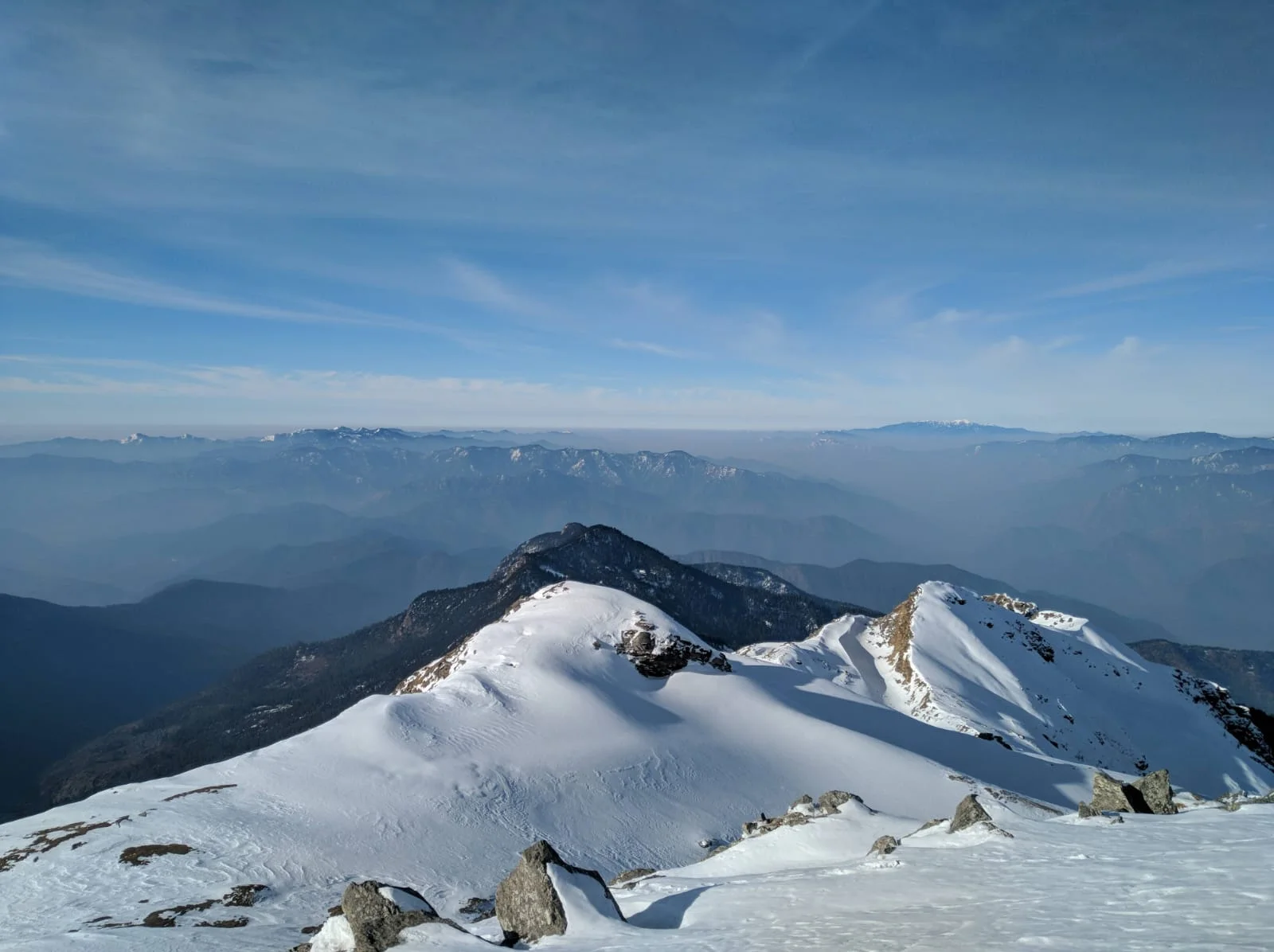
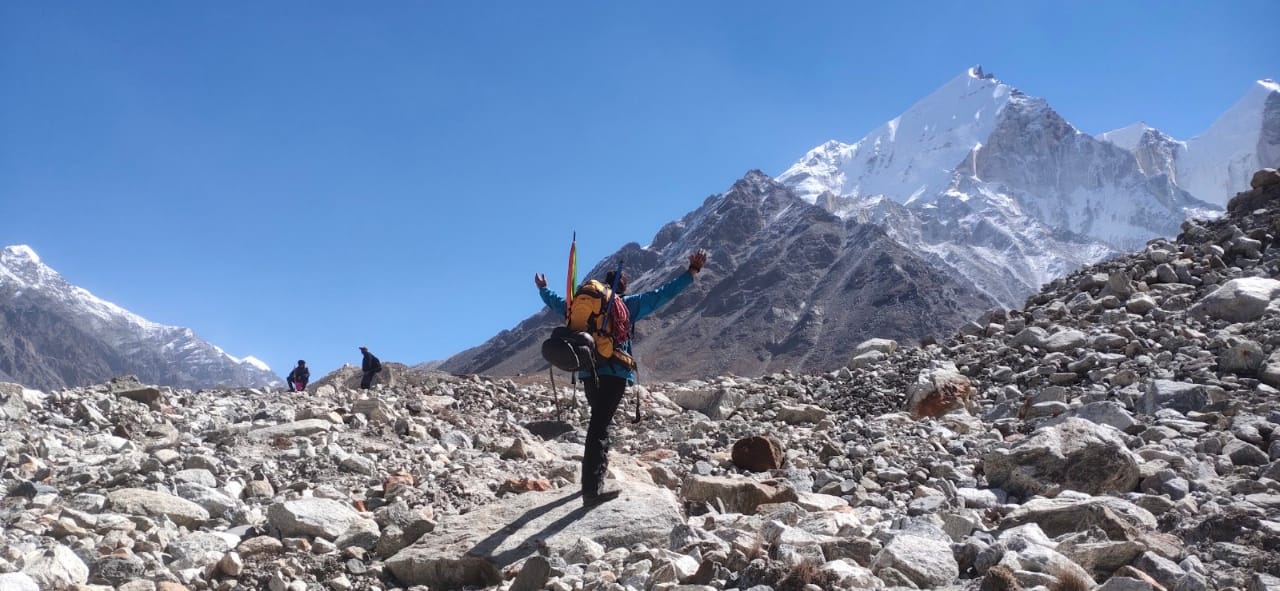
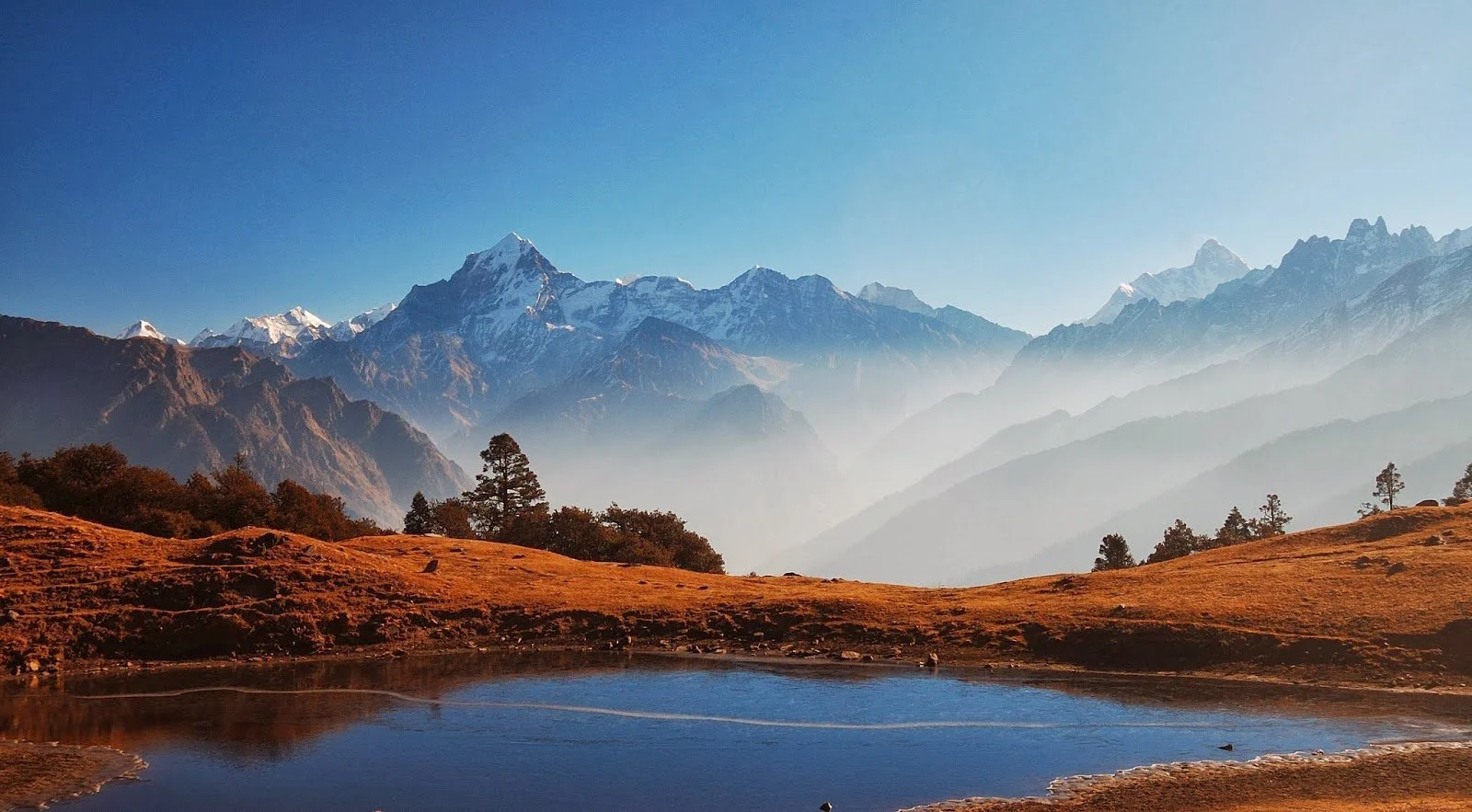
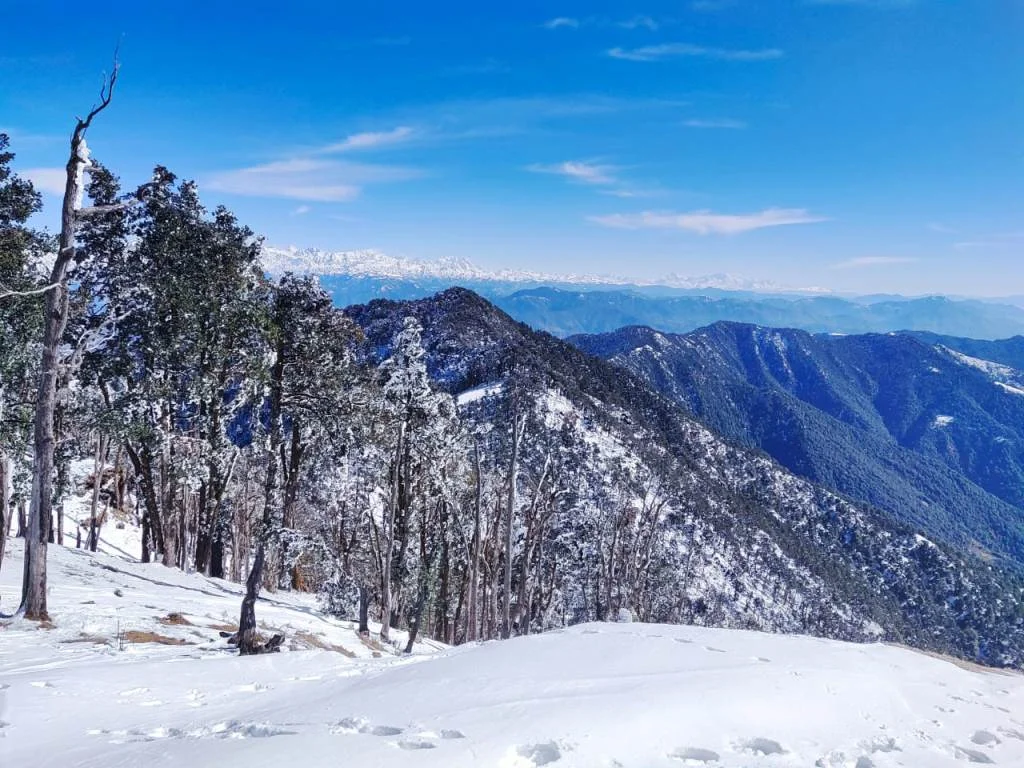
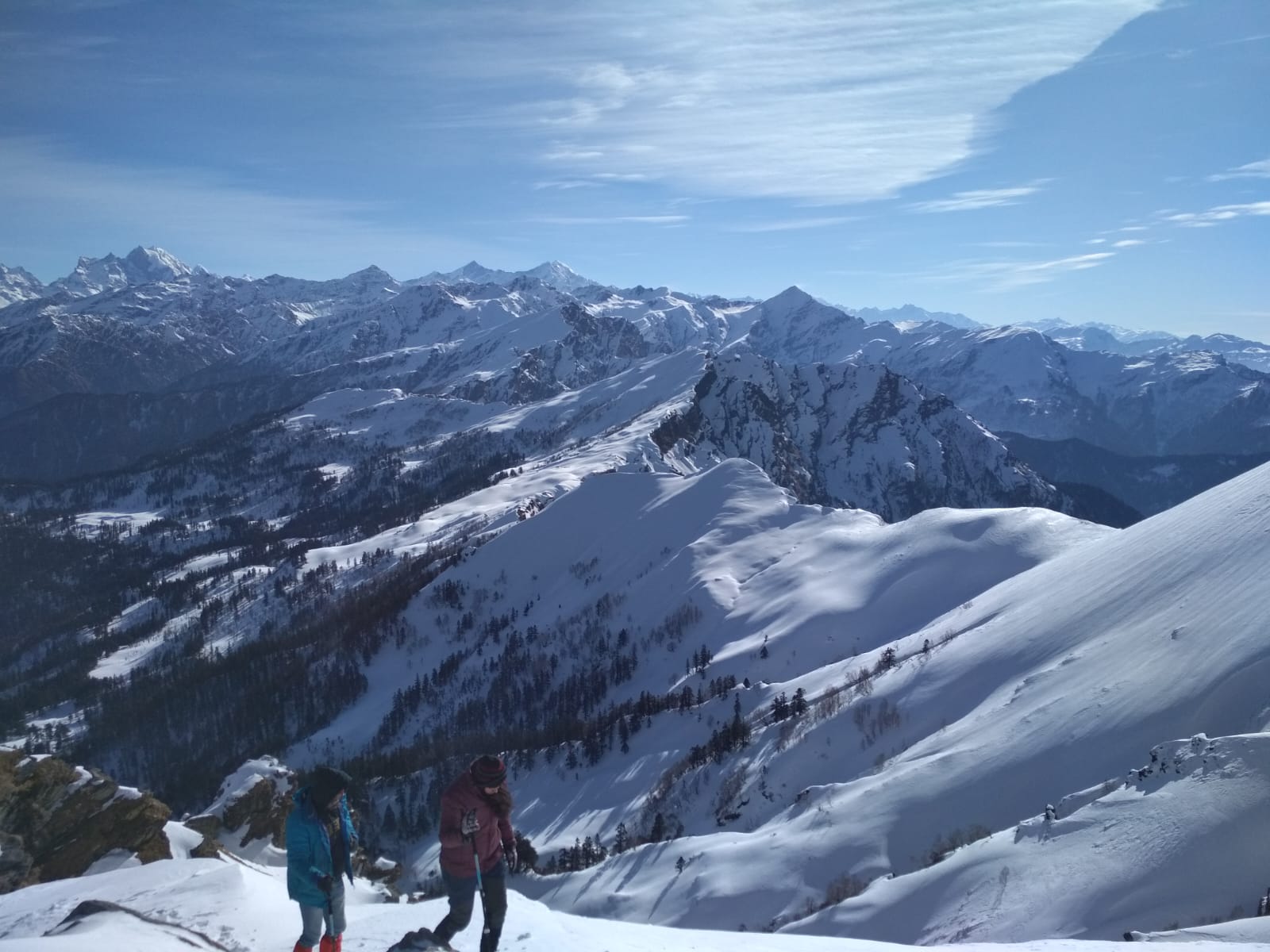
For many trekkers, a first winter trek in India begins with a photograph. A trail covered in fresh snow, pine trees wearing white, distant Himalayan peaks and a tiny group of trekkers walking through an apparently magical landscape can make anyone want to experience a snow trek in India. But there is an important difference between choosing a trek because it looks beautiful and choosing one that is genuinely suitable for your first winter adventure.
Not all winter treks in India offer the same experience. Some take you through relatively gentle forest trails where snow gradually becomes part of the landscape. Others involve steep climbs, deeper snow, longer summit days, freezing nights and more demanding high-altitude terrain. Two treks can both be marketed as “snow treks” while feeling completely different under your feet.
That is why choosing the best winter trek in India for beginners isn't really about finding one universally perfect trek. It is about finding a trek that matches your fitness, previous trekking experience, comfort with cold weather, altitude tolerance and expectations.
If you have never trekked in snow before, the right question isn't simply, “Where can I see the most snow?” A better question is, “Which winter trek will allow me to experience snow while still being within my current ability?”
That distinction can make your first Himalayan winter trek an unforgettable introduction to the mountains rather than an unnecessarily difficult experience.
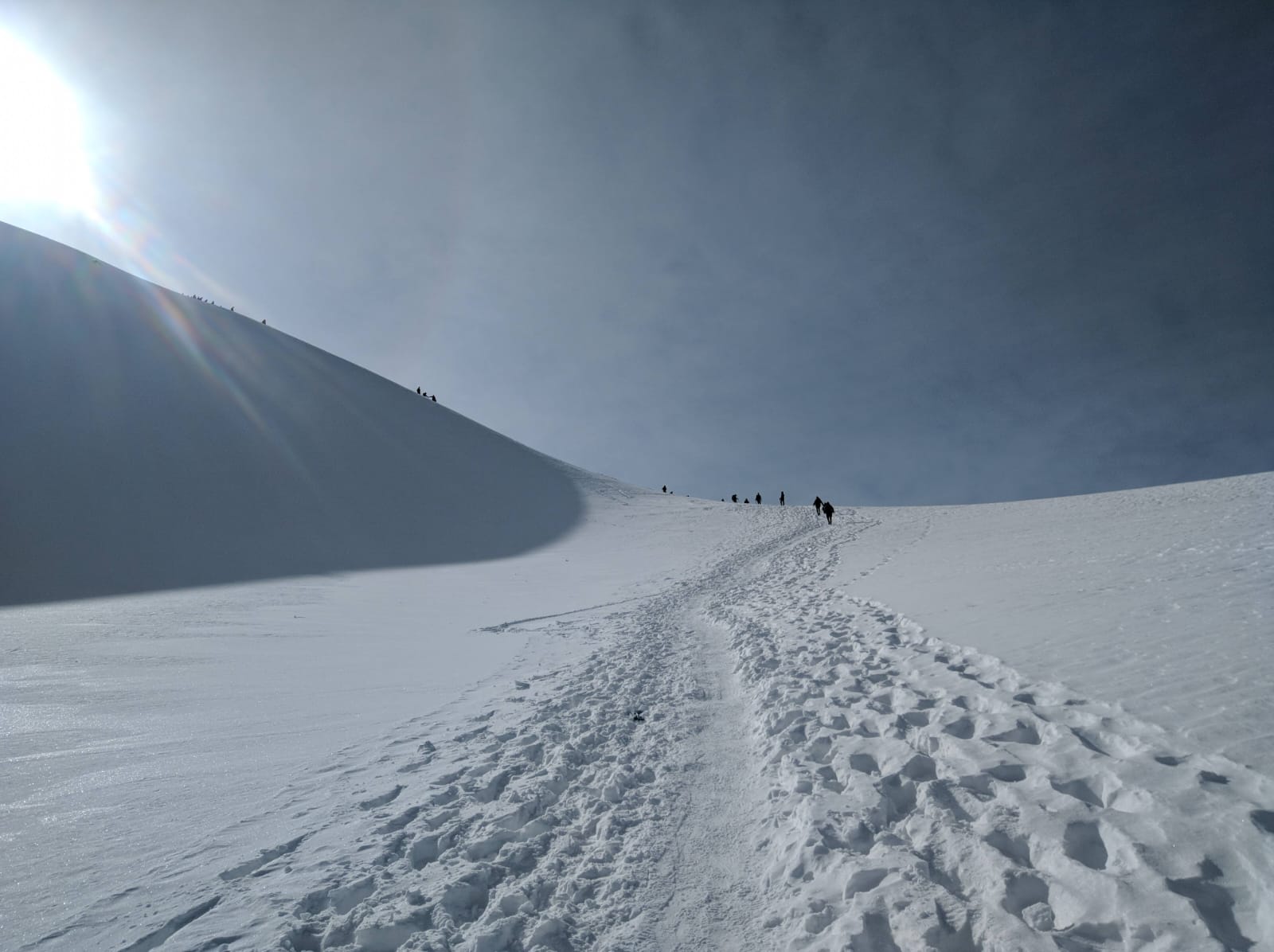
A winter trek in India isn't simply a normal trek with snow added to the photographs. Winter changes the conditions of the trail, the way your body responds to the environment and the kind of preparation you need before setting out.
During the warmer trekking seasons, a trail may be clearly visible and relatively easy to follow. In winter, snowfall can cover familiar sections of the route and change the texture of the ground. A path that was straightforward to walk on dry soil can become slippery, soft or uneven when covered with snow. If fresh snowfall occurs, the effort required to move through it can increase considerably.
Cold also changes the trekking experience. At altitude, temperatures can fall significantly after sunset, and the combination of cold air, wind and physical exertion can make conditions feel much harsher than they appear in photographs. You may begin the morning wearing several layers and gradually remove some as your body warms up while walking, only to need those layers again when you stop.
Daylight is another factor. Winter days can feel short, which means trek schedules have to account for available daylight, weather and the time required to reach a campsite or return from a summit attempt.
Your equipment also becomes more important. A regular hiking jacket may not be sufficient for a cold Himalayan night. Footwear needs to provide dependable grip, clothing must be layered intelligently and your sleeping system needs to be appropriate for the expected temperature.
This is why winter trekking in India requires a little more preparation than simply packing a sweater and heading towards the mountains.
The good news is that you don't need to be an expert mountaineer to enjoy a winter trek. The key is choosing a route whose difficulty and conditions match your experience.
One of the biggest misconceptions among first-time trekkers is that the amount of snow determines the difficulty of a trek. It doesn't.
A trail with relatively little snow can still be physically demanding if it involves substantial elevation gain. Conversely, a snow-covered trail may feel manageable if the gradient is gentle and the route is well established.
The winter trek difficulty for beginners should therefore be assessed using several factors together. Altitude, total distance, daily elevation gain, steepness, terrain, summit-day duration, weather and the likelihood of deep or fresh snow can all influence how challenging the experience becomes.
Consider two hypothetical trails. The first gradually climbs through a forest and reaches a moderately high campsite, with short walking days and gentle gradients. The second may have beautiful snow but involve a long ascent on the summit day, significant altitude gain and several hours of continuous climbing. Both can be called snow treks in India, but they are not equivalent experiences for a beginner.
Altitude deserves particular attention. Your body has to adapt to reduced oxygen availability as you ascend, and this adaptation doesn't depend entirely on how fit you are. A person who can run several kilometres at sea level can still find high-altitude trekking demanding.
Terrain matters too. Walking on compacted snow is very different from walking through loose, deep snow. Icy sections require more careful foot placement, while steep snowy slopes require greater balance and confidence.
Therefore, when searching for the easiest snow trek in India for beginners, don't simply look for a trek described as “easy.” Understand what makes it easy. Is the elevation gain gradual? Are the walking days manageable? How high does the route go? What are the usual winter conditions? How much snow is typically encountered?
Those questions will tell you much more than a single difficulty label.
The best winter trek for beginners depends heavily on what you already know about trekking.
If you've never trekked before, your first Himalayan winter adventure should ideally give you time to understand how your body responds to prolonged walking, altitude and cold. A relatively manageable route with controlled daily distances can help you learn basic mountain skills without overwhelming you with several challenges at once.
If you have already completed a few easy treks in India, your situation is different. Perhaps you've walked for six or seven hours on uneven terrain, carried a backpack and experienced changing weather. In that case, you may be ready for a more demanding beginner winter trek, provided your fitness and preparation match the route.
Then there are trekkers who have considerable summer or monsoon trekking experience but have never walked on snow. For them, the biggest learning curve may not be endurance at all. It may be adapting their walking technique and equipment to winter conditions.
Snow requires more deliberate movement. Your normal walking pace may become slower, and maintaining balance can require greater concentration. You may also discover that stopping frequently in freezing conditions isn't always comfortable, so managing your clothing and effort becomes part of the experience.
This is why the question “which snow trek is best for beginners?” has no single answer.
A complete beginner and an experienced summer trekker can have completely different definitions of “beginner.” The best approach is to assess your actual experience honestly rather than choosing a trek because it is popular or looks spectacular on social media.
Your first snow trek should challenge you enough to feel like an adventure, but not so much that the entire journey becomes an exercise in simply trying to survive the itinerary.
When people compare Himalayan winter treks, they often focus on snow and overlook altitude. For a first-time trekker, this can be a mistake.
The higher you climb, the thinner the air becomes. Your body receives less oxygen with each breath compared with what it is accustomed to at lower elevations. This is why altitude can make a trek feel physically different even when the walking distance doesn't appear particularly intimidating.
A trek's altitude gain matters just as much as its highest point. Climbing gradually gives the body more opportunity to adapt, whereas gaining elevation quickly can make the experience considerably harder.
This is also why physical fitness alone doesn't guarantee an easy experience at altitude. Being fit certainly helps you handle the physical workload, but altitude adaptation is a separate process.
A sensible first winter trek in India should therefore be selected with altitude in mind. Look at the highest point of the trek, the altitude of overnight camps and how quickly the itinerary gains elevation.
Acclimatisation should also be taken seriously. A responsible itinerary gives trekkers an appropriate opportunity to adjust to increasing altitude rather than treating the mountain like a race.
Pay attention to how you feel as you climb. Headaches, unusual fatigue, dizziness, nausea or other symptoms should never simply be dismissed as weakness. If you feel unwell at altitude, inform your trek leader and follow the safety protocol of the trekking team.
The goal of a winter trek is to experience the mountains, not to prove that you can ignore what your body is telling you.
This is perhaps the most misunderstood aspect of choosing a snow trek for beginners.
When people imagine their first winter trek, they often picture deep, untouched snow covering the entire trail. Visually, that may be exactly what attracts them to winter trekking. Physically, however, deep snow can make a trail much more demanding.
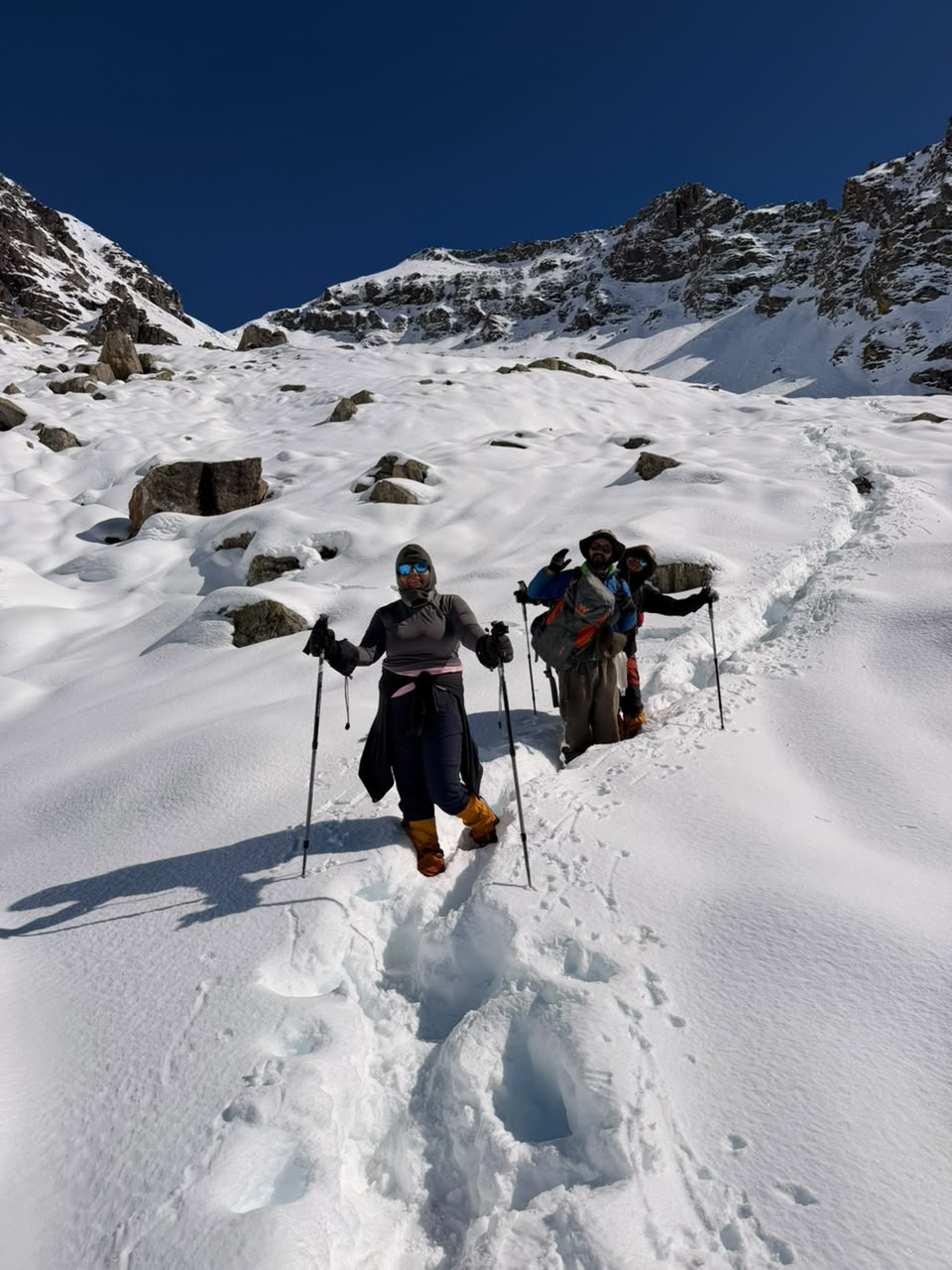
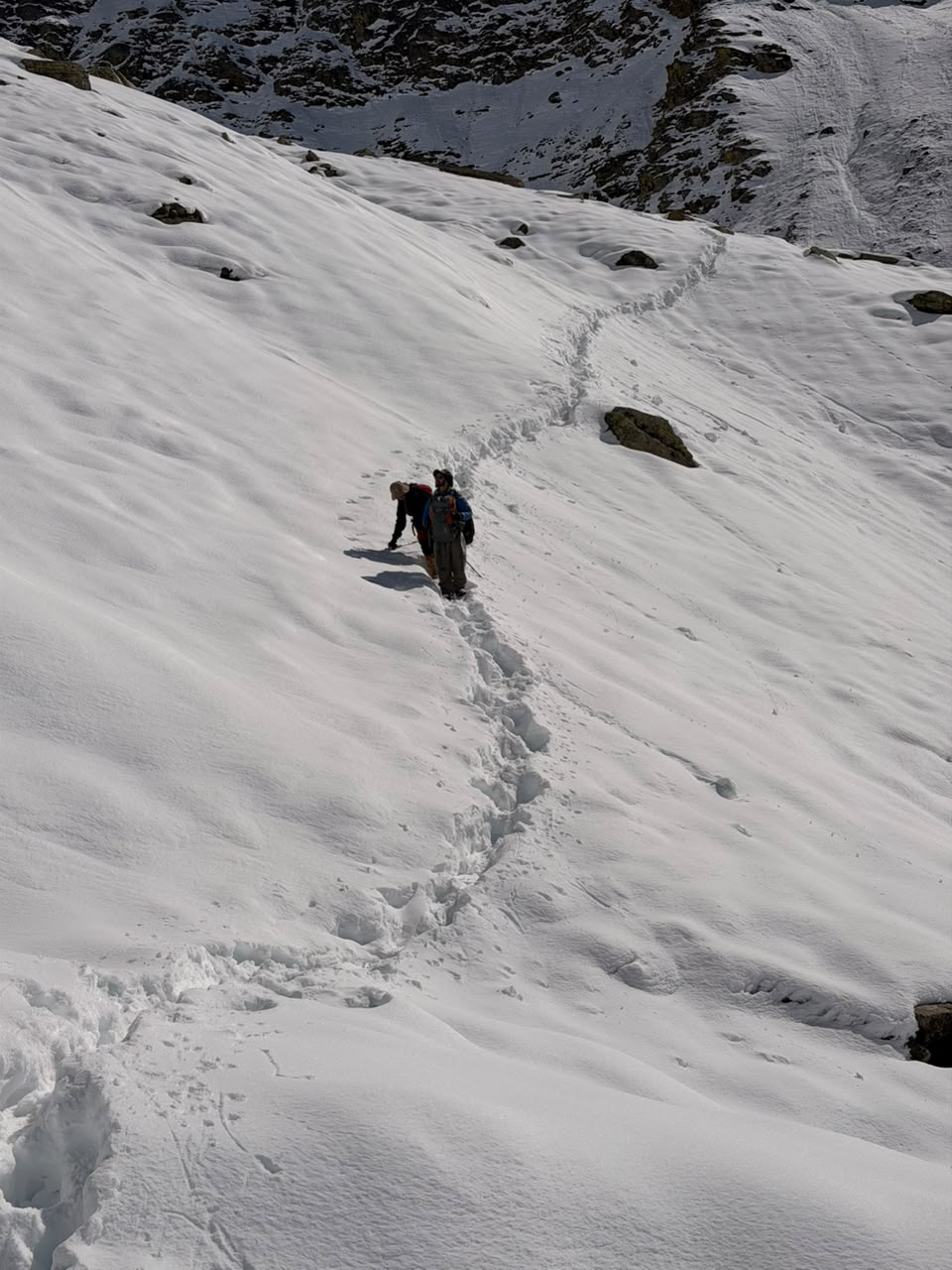
Fresh snow doesn't always provide a firm surface to walk on. Your feet can sink with each step, requiring considerably more effort than walking on a compact trail. If the snow has melted slightly and refrozen, the surface can become hard and slippery. When temperatures fluctuate, conditions can change even within the same day.
There is also a difference between snow-covered scenery and snow-dominated trekking.
A trek can offer beautiful snowy landscapes while still having sections of relatively firm trail. For a beginner, that can be a wonderful introduction to winter trekking. You experience snow, cold-weather camping and Himalayan landscapes without necessarily spending every kilometre struggling through deep snow.
This is an important consideration when looking for the best snow trek in India for beginners.
Don't judge a trek only by photographs showing the deepest snowfall. Ask about the type of snow normally encountered during the period you intend to travel, how frequently fresh snowfall occurs and whether the route is generally compacted or involves extensive walking through fresh snow.
Conditions can also change from one departure to another. A trail that was relatively easy one week may become more demanding after a significant snowfall.
That is why current trail and weather information is more useful than relying entirely on photographs from previous seasons.
For your first winter adventure, the ideal experience is not necessarily the trek with the deepest snow. It is the trek where the combination of snow, altitude, terrain, temperature and walking distance matches your ability.
And that is the central idea behind choosing your first winter trek in India: don't choose the mountain simply because it looks the most dramatic. Choose the one that allows you to experience winter in the Himalayas while still giving you the confidence to enjoy every step of the journey.
Snow looks beautiful, but the real challenge of a winter trek in India is often the cold rather than the snow itself. A photograph can show a bright, sunny trail covered in white, but temperatures at higher camps can fall dramatically after sunset. Wind can make the conditions feel even colder, particularly when you are standing still or starting your morning before sunrise.
This is why choosing a first winter trek in India should involve thinking about your relationship with cold weather. There is a significant difference between enjoying a chilly winter morning in the city and spending several hours outdoors at altitude, followed by a night in a tent.
Your clothing system becomes particularly important. Instead of relying on one extremely thick jacket, winter trekking works better when you use layers that can be added or removed according to your activity level. A base layer helps manage moisture, an insulating layer provides warmth and an outer layer protects you from wind or precipitation. Warm socks, gloves and head protection are equally important because extremities can become uncomfortable quickly in freezing conditions.
You should also understand that you may feel warm while climbing and suddenly become cold when you stop. This is one reason experienced trekkers manage their layers throughout the day rather than waiting until they are already uncomfortable.
For someone searching for a beginner winter trek, temperature should therefore be considered alongside altitude and snow conditions. You don't have to choose the coldest destination to prove that you are capable of winter trekking. Your first experience should help you understand how your body responds to the environment.
When comparing snow treks in India, many beginners look at the total trekking distance and assume that the shorter trek must automatically be easier. This isn't necessarily true.
Imagine one trek covering a moderate distance over several days with gradual climbs and plenty of time to rest. Another may cover fewer kilometres but include a steep ascent on the summit day. The second trek could feel considerably harder despite having a shorter total distance.
This is why winter trek difficulty for beginners should be assessed by looking at the daily itinerary rather than just the overall kilometres.
Pay attention to how many hours you are expected to walk each day, how much elevation you gain, how steep the route becomes and whether the itinerary includes a particularly demanding summit day. A short but steep climb through snow can require more effort than several kilometres on a relatively level trail.
Walking on snow can also slow your pace. Even when the distance appears manageable on paper, conditions underfoot can make the actual walking time longer. You need to allow yourself enough time to walk carefully rather than trying to maintain your normal hiking speed.
This is particularly relevant when looking for the easiest snow trek in India for beginners. A trek with sensible daily stages can give a new trekker the opportunity to enjoy the landscape, photograph the surroundings, recover properly at camp and adapt to the rhythm of mountain life.
The best winter trek isn't necessarily the one with the shortest route. It is the one whose daily demands match what you can realistically handle.
There is no single answer to the question, “Which snow trek is best for beginners?” Your ideal trek depends on what kind of experience you are looking for and how much trekking experience you already have.
For someone completely new to Himalayan trekking who wants the classic combination of forest trails, snow and a summit experience, Kedarkantha trek is one of the names worth considering. Its popularity also means that it is often discussed as a beginner winter trek, although beginners should still prepare properly for altitude, cold and the summit climb.
If your priority is scenery and open Himalayan meadows, Dayara Bugyal trek can be an attractive option to explore. Its broad landscapes create a very different experience from a narrow forest trail, and winter can transform the meadows into a striking snow-covered landscape. As with any Himalayan trek, however, actual winter conditions can change the difficulty of a particular departure.
For trekkers who want something less mainstream, Gulabi Kantha trek offers another Himalayan winter experience. It can appeal to people who want to explore a quieter or less familiar route rather than immediately choosing the most famous snow trek in India.
Then there are treks such as Kuari Pass trek, which can be more appropriate for someone who already has trekking experience and wants to move towards a more demanding Himalayan adventure. A trekker shouldn't choose a route simply because it is labelled among the best winter treks in India. The more useful question is whether its terrain, altitude and itinerary suit their present ability.
This distinction is particularly important for beginners. A trek can be spectacular and still be the wrong first trek for you.
When comparing the best Himalayan snow trek for beginners, consider your previous trekking experience, fitness, tolerance for cold, comfort with altitude and the kind of landscape you want to experience.
Good equipment doesn't make a difficult trek easy, but inadequate equipment can make a manageable trek unnecessarily uncomfortable.
For a snow trek for beginners, footwear deserves particular attention. Your shoes need to provide adequate grip and protection for the conditions you are likely to encounter. Depending on the trail and season, gaiters may also be useful for preventing snow from entering your footwear.
Clothing should be approached as a system rather than as a collection of random winter clothes. Thermal or moisture-managing base layers, insulating mid-layers and a protective outer layer allow you to adapt to changing conditions. A warm insulated jacket becomes particularly important during rest periods and at camp when you are no longer generating as much body heat through walking.
Your winter trekking gear should also include suitable gloves, warm socks, a cap or other head protection, sunglasses, sunscreen, a headlamp, water bottles and a backpack appropriate for the duration of the trek.
Snow and sunlight create another issue that beginners sometimes overlook. Bright sunlight reflecting off snow can be intense, even when the surrounding air feels freezing. Good-quality sunglasses and adequate sun protection are therefore important parts of your preparation.
The exact equipment list should always be based on the season, route and expected conditions. You don't necessarily need to purchase expensive equipment for every item. Some specialised gear can be rented if you are attempting your first winter trek in India and don't yet know whether you will continue winter trekking regularly.
The objective is not to carry the most equipment. It is to carry the right equipment.
A beginner winter trek still requires preparation. You don't need to become an athlete before going to the Himalayas, but you should be comfortable walking for several hours and climbing continuously without becoming completely exhausted.
Cardiovascular fitness helps you maintain a steady pace over longer periods. Walking, jogging, cycling or other aerobic activities can help build endurance. Strength training can complement this by preparing your legs and core for climbing, descending and carrying a backpack.
Stair climbing is particularly useful because it introduces repeated elevation gain. Regular walking with a moderately loaded backpack can also help you understand how your body responds to carrying your trekking gear.
Ideally, begin preparing several weeks before your trek rather than trying to compensate for months of inactivity with intense exercise immediately before departure. Consistency matters more than a sudden increase in training.
Fitness is also about recovery. If your legs remain extremely sore after every training session, your preparation may be too aggressive. Your body needs adequate rest between demanding workouts.
For someone searching for how to choose your first winter trek, fitness should be one of the deciding factors. If you are currently comfortable with only short walks, choosing a demanding multi-day snow trek may not be the best starting point. Build your endurance first and then select a route that fits your current level.
For a first-time trekker, choosing the right trekking company can be just as important as choosing the right mountain.
Look beyond attractive photographs and low package prices. A reliable trekking company should have a clear itinerary, experienced trek leaders, appropriate equipment, sensible group management and an established approach to emergencies.
This becomes particularly important during winter trekking in India, when weather can change rapidly and snow can alter trail conditions. A good trekking team should be prepared to modify plans when conditions make it necessary rather than treating the itinerary as something that must be followed at any cost.
Ask questions before booking. Understand what equipment is provided, what you need to bring yourself, how the team handles altitude-related concerns and what happens if weather forces a change in the itinerary.
Transparent communication is a good sign. You should be able to understand what you are paying for and what responsibilities remain yours.
A responsible trekking company should also encourage trekkers to respect the mountain environment. Winter doesn't make fragile Himalayan ecosystems immune to damage. Carrying waste back, avoiding unnecessary disturbance to wildlife and following established trails remain important.
One of the most common mistakes is choosing a trek purely because of its photographs. Social media often shows the most dramatic snow conditions, the clearest skies and the most beautiful moments. It rarely shows the cold mornings, long climbs, tired legs or changing weather that are also part of the experience.
Another mistake is assuming that physical fitness alone is enough. A fit person can still be unprepared for altitude, cold or walking through snow.
Wearing unsuitable footwear is another avoidable problem. Casual sports shoes may look perfectly comfortable at home but can become unreliable on snow, ice or wet mountain terrain.
Beginners also tend to overpack. Carrying unnecessary items increases the weight on your back and makes every climb harder. At the same time, underpacking essential cold-weather equipment can leave you uncomfortable and potentially unsafe.
Perhaps the biggest mistake is treating a winter trek like a race. Mountains reward patience. Maintaining a sustainable pace, staying hydrated, eating properly and communicating with your trek leader are much more valuable than trying to reach camp before everyone else.
Before booking your first winter trek in India, ask yourself a few fundamental questions.
Can you comfortably walk for several hours? Are you prepared for sleeping in cold conditions? Do you understand the highest altitude of the trek? Are you comfortable with the expected daily elevation gain? Do you have suitable winter trekking gear, or can you arrange it responsibly? Have you considered the possibility that weather could change the itinerary?
You should also investigate the trek's expected winter conditions rather than relying on photographs from previous years. Snowfall varies, and the same trail can offer a different experience from one season to another.
Finally, be honest about your expectations. If your primary goal is simply to experience walking through snow, you don't necessarily need the highest or most difficult Himalayan winter trek. If you already have substantial trekking experience and want a greater challenge, you can choose accordingly.
The best winter trek in India is ultimately subjective. The right choice is the one that combines the level of adventure you want with the level of difficulty you can responsibly handle.
Your first encounter with the winter Himalayas should be about discovering what makes the mountains special—not about proving how much difficulty you can tolerate.
There are countless snow treks in India, but each offers a different combination of altitude, terrain, snowfall, temperature, walking hours and physical demands. Understanding those differences is the key to finding the right route.
If you're wondering which snow trek is best for beginners, start with yourself. Consider your trekking experience, fitness, comfort with cold and willingness to prepare. Then compare those factors with the demands of the trek.
The most memorable winter trek in India for beginners may not be the one with the deepest snow or highest summit. It may simply be the one that challenges you enough to feel adventurous while allowing you enough confidence and energy to stop, look around and realise just how extraordinary the winter Himalayas can be.