Packing Rucksack Guide
Packing Rucksack Guide
01
May
1 Packing a rucksack is a skill that every outdoor enthusiast should practice, If the rucksack is not packed and fitted properly, it will make the carrying of load difficult. A well packed and ined nucksack makes it easier to carry heavy loads
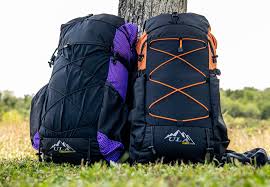
Internal frame packs tend to be lighter and have lower profile than external frame packs.
They're wider and fit further away from the body, they're less stable than internal frame packs. They're easy to organize and because of the space between your body and the pack, your back won't get as sweaty. The external frame can also be used to carry any load other than a rucksack
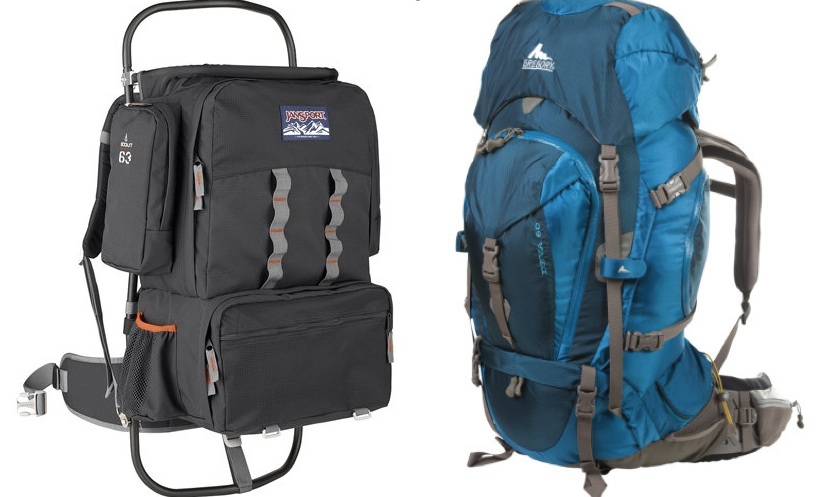
(i) Weekend (1-3 nights: 30-50 litres).
(ii) Multiday (3-5 nights; 50-80 litres).
(iii) Extended trip (5+nights; 70 litres or more).
(iv) High altitude expeditions (90 litres or more).
(i) Rucksacks offer a wide variety of storage compartments, pockets, and sleeves.
(ii) Items not needed until the end of the day should go deep inside.
(ii) Accessibility options are available in forms of top-loading, front-loading and bottom loading. The rucksack should have adequate loops to attach equipment as required, like ice axe, etc.
Tone length matters most, not your height. it should have an ergonomic fit.
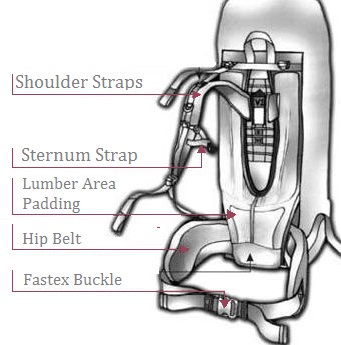
Parts of a rucksack
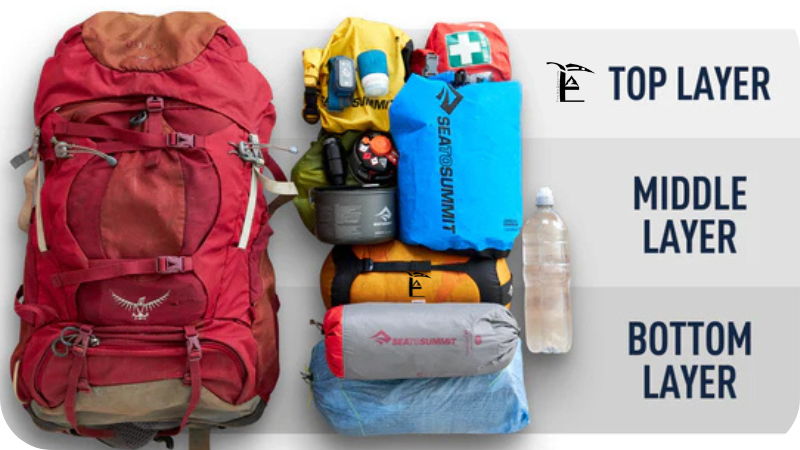
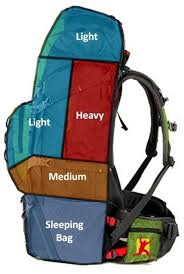
Think of the items you will require enroute before reaching the camp site. These things should be easily accessible. Items like a raincoat, water bottle, sunscreen, hat and snacks should be at the top of your pack.
Weight should be equal on both the shoulders. The key is to put the light items like sleeping bags at the bottom and placing heavy items in the middle of the pack, closest to your own back. If your pack isn't weighted properly, hiking with it can be painful and dangerous. Distribution of weight of items side to side should be balanced.
Keep your gear tight and compressed in your bag. If you have compression sacks, use those to compress other gear inside the bag. Loosen all the straps, then shove everything inside. Do not worry about the neatness of anything. Just fill every space in your pack Tighten the compression straps after packing the rucksack to make it more compact
Keep the rucksack dry at all times, a wet sack is heavier to carry and it renders the contains unusable.
Everything should be in the bag, nothing should hang outside. Things hanging outside are likely to fall with movement. Few things which do not fit inside or may be required on the way, should be properly secured outside.
A common mistake is to lift a pack by a single shoulder strap. Not only can this damage and prematurely wear out your sack, it also makes it difficult to control your pack as you try to wrestle it onto your back.
(a) Loosen all of your straps slightly to make the pack easier to slip on.
(b) Tilt your pack to an upright position on the ground.
(c) Stand next to the back panel; have your legs well apart and knees bent.
(d) Grab the haul loop (the webbing loop at the top of the back panel on your pack).
(e) control Lift and slide the pack up to your thigh and let it rest; keep your hand on the haul loop for
(f) Slip your other arm and shoulder through one shoulder strap, until your shoulder is cradled by the padding.
(g) Lean forward and swing the pack onto your back. Now slip the hand that was holding the haul loop through the other shoulder strap.
(h) Buckle up and make your usual fit adjustments.
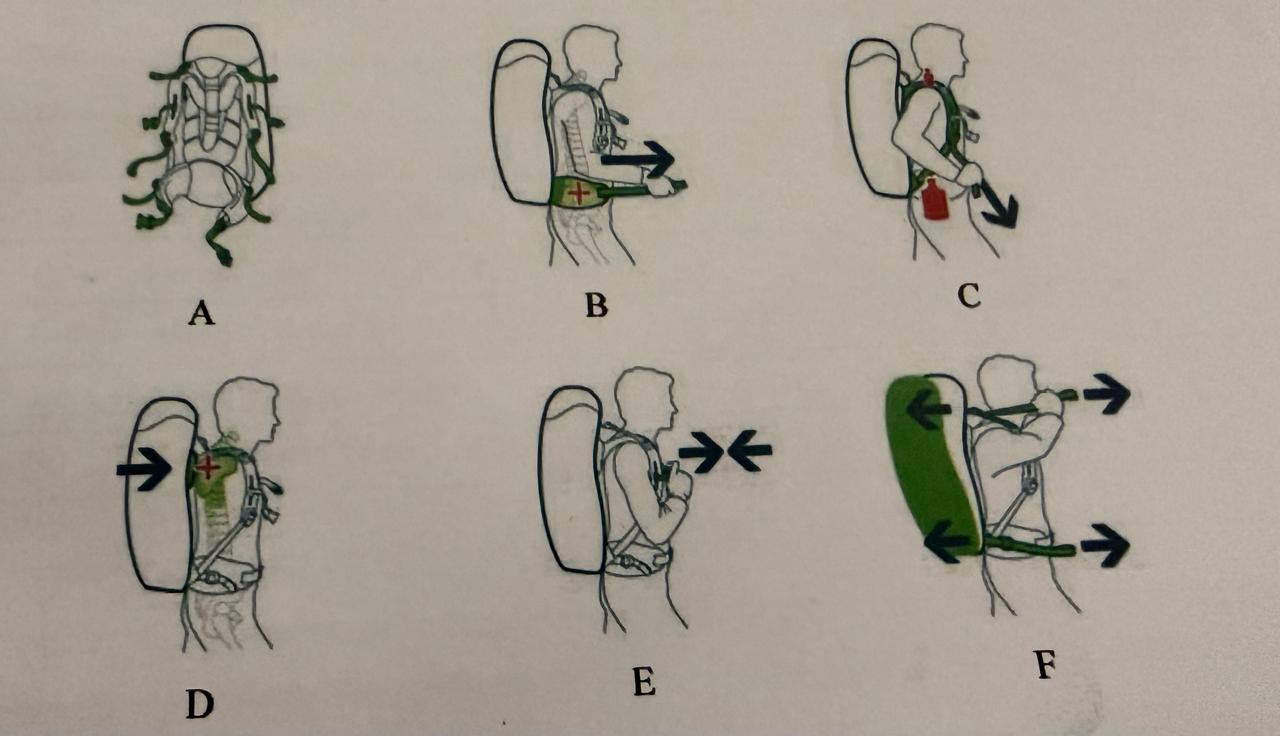
(a) Loosen all straps. This will set you up to make all the right adjustments. Put the pack on.
(b) Position the middle of the hip belt over the hip bones and tighten. The main weight should be on the hip belt.
(c) Now tighten the shoulder straps, but not too tightly.
(d) Adjust the load stabilizer straps. These are used as the name suggests to stabilize the load near the top of the pack. To perfectly fulfil their function, the stabiliser straps should be horizontally angled between 30° and 45°
(e) Fit and adjust the chest strap for a comfortable fit.
(f) Attach and adjust sternum strap, so that it's comfortable and does not restrict breathing The sternum strap will help to keep the shoulder straps positioned on the chest.